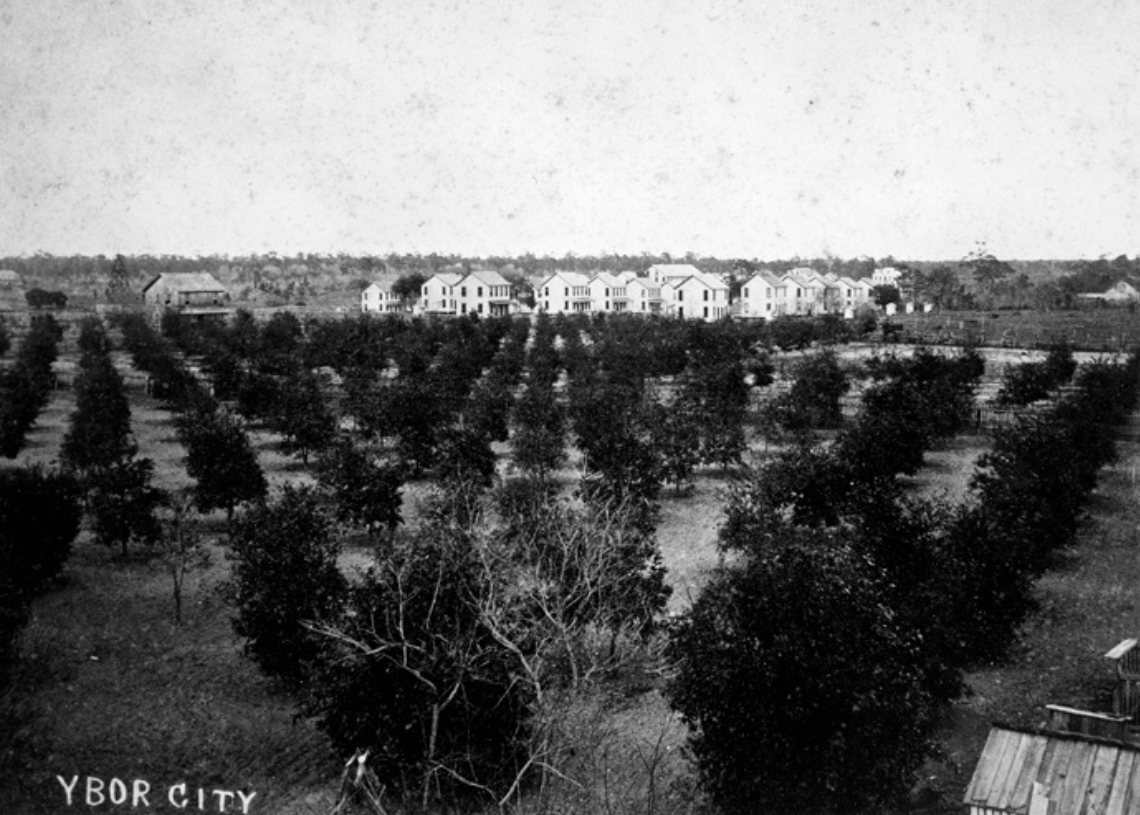
In 1885, Vicente Martínez Ibor sat down at the negotiating table with the Tampa Board of Commerce to sign the purchase contract for 40 acres of land. It was a risky decision. At that time, Tampa’s population barely exceeded 800 inhabitants — mostly farmers and fishermen. It was an unremarkable hamlet with a stagnant economy, a place that Americans from “the North” tended to look down upon as a zone of heat, swamps and vermin — hardly a desirable place to live.
Even so, the 66-year-old Valencian possessed a bold vision, sparked during a conversation among friends when he first heard about the hidden potential of the environs of Tampa. As it happened, in 1884, his compatriot Gavino Gutiérrez had explored the area alongside the Cuban Bernardino Gargol while searching for guavas for the latter’s canning business. They did not find what they were looking for, but they did perceive the abundance of virgin land, the magnificent bay — the Bay of the Holy Spirit (Bahía del Espíritu Santo), where the conquistador Hernando de Soto had landed in 1539 — and the parallel lines of the railroad laid down by Plant.
These means of transportation would prove key to opening the area to the currents of modernization, while also guaranteeing the inflow of imported tobacco leaf and the export of the finished product. What began as a plan to establish a colony of cigar makers evolved into something far greater: Ybor City — a prosperous, multicultural and spirited community that would contribute to the transformation of Tampa into one of the major capitals of the state of Florida.
Those 40 acres would forever alter the destiny of Martínez Ibor and that of the entire region. The world that emerged from that epicenter was created by men with strong hands and clear dreams, people of diverse backgrounds who arrived with the hope of a better life.
A pioneer from Valencia
Vicente Martínez Ibor was born on September 7, 1819, in Valencia. He was around fourteen years old when his family put him on a ship bound for Cuba, with the dual intention of sparing the boy from military service and enabling him to make his fortune. In Havana, he began working in a grocery store, but his forward-looking nature led him to focus his attention on one of the island’s most flourishing industries: tobacco.
Leveraging his gift for business, by 1854 he managed to launch his own enterprise under the brand El Príncipe de Gales, which gradually gained prestige among both aficionados and outsiders alike. His reputation even enabled him to subcontract prisoners from the Havana Jail to work in his workshop. Nevertheless, he openly opposed the continuous rise in tobacco taxes and in 1868, when Céspedes declared the war for independence, Martínez Ibor demonstrated his liberal convictions by siding with the Cubans, whom he supported with funds.


That daring decision earned him the enmity of the Volunteers (pro-Spanish militias). Weary of inflated taxes and seeking to avoid arrest, he boarded a schooner and set sail for Key West with those he loved most: his family. He had fathered four children during his first marriage; after being widowed, he remarried in January 1874, taking Mercedes de la Revilla — 32 years his junior — as his wife, with whom he would have eight more children.
Upon his departure, Don Vicente packed his entrepreneurial drive alongside his luggage. In Key West, he once again established his cigar-making business. He lived for seventeen years on that rocky islet where so many Cubans had found refuge, though his business did not prosper as he had hoped. On several occasions, he had to contend with transportation bottlenecks for his goods, labor instability and workers’ strikes that generated financial losses. Then came that fateful gathering in which Gavino Gutiérrez sold him on the idea of relocating his operations to Tampa, a city that held promise in many respects.
The Key West fire — which broke out in early April 1886 and left the islet reduced to charred rubble — hastened his departure. Just days after the fire, Martínez Ibor stepped off the steamship Mascotte onto the Tampa docks, envisioning a new future. He was blazing a trail.
A model city
Standing beside Vicente Martínez Ibor in October 1885, the engineer Gavino Gutiérrez traced in the wind with his fingers the layout of the first streets, the quadrants where the houses would stand and the site where the cigar factory would be built. Eduardo Manrara — who, since their days in Cuba, had been Martínez Ibor’s shadow — was an indispensable figure. A native of Camagüey with a background in banking, Manrara distinguished himself as a key ally and an essential force in the genesis of this burgeoning urban development.
This new spot on the map, located a mile and a half northeast of Tampa, was officially registered under the name Cubatown. However, that designation soon faded away, supplanted by popular usage, which favored the surname of the project’s visionary. Thus was born Ibor City — spelled “Ybor” in its English adaptation — a suburb linked to neighboring Tampa by a meandering ribbon of small houses, scattered haphazardly like an untamed vine. Tampa, with its insatiable demographic appetite, devoured it entirely around the year 1887.
The settlers’ drive transformed the site’s once-inhospitable landscape. Under the auspices of the Ybor Landscape Co., this “promised land” gradually took shape. They drained wetlands, filled in low-lying areas and leveled the terrain; they built factories, shops, homes, schools, clinics, churches, bookstores, theaters, hotels and insurance companies. Hand in hand with this development, they paved the sandy streets, dug wells to ensure a water supply and, with the advent of electric lighting, brought illumination to homes and paved the way for the streetcar.
The community prospered at a breakneck pace, and the value of the land skyrocketed. As La Unión Constitucional highlighted on February 9, 1890: “The success achieved by Mr. Martínez Ibor in Tampa is well known; through his enterprise, he is developing a city that will soon rival the importance of neighboring counties — lands that, just eight years ago, held almost no value, with acres selling for 25 cents, yet today fetch between $500 and $1,000. Houses for workers are being built for less than $200 each — easy to rent at a modest price and yielding a high return.”
From the very beginning, two tobacco factories were established: Martínez Ibor’s own factory and La Flor de Sánchez Haya, the latter owned by Ignacio Haya and Serafín Sánchez and which had relocated from New York in search of a better climate and Cuban labor. Cubans constituted the largest ethnic group and the Spanish language predominated.
According to the 1892 census, Tampa was home to 5,532 inhabitants, 2,424 of whom were Cubans hailing from Key West who had settled in Ybor City and West Tampa.
Five years later, those numbers continued to swell. In a special edition of the magazine Cuba y América (July 1897), journalist Carlos Trelles wrote: “Tampa’s Fourth District consists of Ybor City, which houses 6,000 people, the majority of them Cuban. Anyone walking along Seventh Avenue or Fourteenth Street would scarcely believe they were in the United States, given the sheer number of native-born Cubans one encounters and the establishments of every kind where one sees nothing but signs in Spanish.” He noted in detail that there were a thousand homes, thirty physicians, ten pharmacists, eight dentists, six lawyers and dozens of Cuban intellectuals.
It was precisely these Spaniards and Cubans — many of them political refugees — who worked in those factories who were the pioneers of that immigrant settlement. Later, Italians, Jews and Chinese arrived. Each immigrant group brought with it memories of their homelands, traditions and talents, weaving an intercultural tapestry that transformed Ybor City into a land of opportunity — an identity forged in hard work, community solidarity and ancestral values.
The Príncipe de Gales
Industrialization reigned supreme in Ybor City. Hundreds of corporations established a vast manufacturing complex that elevated the region to the status of an industrial empire. Once the flame was lit, this bustling industry went on to generate and export millions in annual revenue, earning the city, in its heyday, the title of the Cigar Capital of the World.
The world of Ybor City revolved around El Príncipe de Gales — the renowned brand that the old administrator established within a sprawling, cottage-style wooden structure on Seventh Avenue. Operations commenced in April 1886. Drawing upon lessons learned from the past, Martínez Ybor sought to foster employee retention and avert labor strikes. To this end, he offered improved working conditions, sold modest employee “small houses” at affordable prices and opened the doors to Black cigar makers, who worked side by side with their white counterparts and earned equal wages.
The plan paid off. By the end of its inaugural year, they were producing 900,000 cigars a month. The factory’s prosperity led them to seek more spacious quarters in a brand-new three-story-high red-brick building with many windows. According to Cuba y América, by mid-1897, 400 workers and 200 leaf-stemmers were employed there. The building housed various departments and, on the top floor, the cigar makers’ tables were arranged alongside the indispensable podium for the reader.
For a time, the cigar factory reader served as the primary spokesperson in Ybor City. The first to hold this position at the Príncipe de Gales factory was José Dolores Poyo, another arrival from the Key West exodus. Poyo seized the opportunity to relaunch his newspaper, El Yara — which he read aloud to the cigar makers — making it the first Spanish-language newspaper published in Tampa. His stay in the city was limited to just a few months, however, as he eventually returned to Key West. He was succeeded by also journalist and patriot Ramón Rivero.
After moving to the new facility, Martínez Ibor donated the original building to the cigar makers to be used for parties and meetings. In 1890, the Liceo Cubano was established there — a society dedicated to hosting artistic, literary and patriotic gatherings. It was adorned with coats of arms, flags and portraits of illustrious Cubans, modeled after the Club San Carlos in Key West. Furthermore, it functioned as a night school directed by Néstor Leonelo Carbonell — a veteran of the Ten Years’ War and a factory reader himself. Dozens of unemployed workers, exiled patriots and separatist clubs found support under the roof of the wealthy Spaniard.
For a suffering Cuba
At the invitation of Néstor L. Carbonell, president of the Club Ignacio Agramonte, José Martí arrived in Tampa just after midnight on November 26, 1891. A crowd of enthusiastic Cubans awaited him at the Ybor City train station. The following morning, he visited the Martínez Ibor factory. The workers greeted his presence with a prolonged clatter of their cutting knives.
Hours later, the inspiring orator stirred the audience that packed the Liceo: “To Cuba, which suffers, the first word. Cuba must be taken as an altar, upon which to offer our lives — not as a pedestal, upon which to elevate ourselves.” He concluded that speech, which would go down in history books with the phrase: “With all, and for the good of all.” That maxim — the epitome of his revolutionary program and his ethical code — still resonates today. On the night of the 27th, he returned to the spacious hall to deliver a tribute to the medical students executed by firing squad in 1871. It was another historic address, remembered as “The New Pines,” in which he celebrated the unity between the young generation and the veteran warriors.
In the wake of that first visit by Martí, the cigar makers of Ybor City and West Tampa pledged to contribute between five and ten percent of their wages to the struggle. There is no need to dwell at length on the role played by the cigar makers in the War of 1895. Martí recognized them as the most solid and steadfast pillar of the independence cause. Their sweat served as the fuel for dozens of expeditions, and quite a few of them traded their cutting knives for machetes and rifles.
Tampa was one of the U.S. cities most frequently visited by Martí and within it Ibor’s factory. A well-known photograph captures him on the iron staircase at the entrance of the cigar factory, surrounded by the humble masses, during a visit in July 1892. Regarding that burgeoning neighborhood, he had written the following on October 31, 1889 in a letter to Félix Iznaga sent from New York: “The secret to success lies in dedicating oneself entirely to an objective. You will surely grow to like Ybor City; indeed, it might not be prudent to let it appear that you show a preference for Tampa. I spoke at length with the Ibors here, and I believe that no unpleasantness awaits you there — only cordiality and delight.”
In Ybor City, paradoxically, Martí was nearly murdered in late 1892. “In Ybor, Tampa, I took to my bed. My illness was not natural, but rather brought on by a villain who attempted to finish me off by poisoning me,” he recorded. He spent his convalescence at the home of Paulina Pedroso, situated across from the cigar factory. She, aided by her husband Ruperto, provided him with maternal care until the horrific fire of the toxin ceased burning within his entrails.
A kindhearted old man
Volume 5 of the Obras Completas features another impression penned by Martí that captures the character of the generous industrialist: “One morning, a certain traveler was in the office of the Martínez Ibor manufactory — down there in Tampa — speaking with one of the workshop’s laborers, who was seated at the owner’s desk. An elderly man with a kindly face entered; the laborer rose to offer him the chair, but the old man placed both hands on his shoulders and left the worker seated in the owner’s seat. It was Don Vicente Martínez Ibor.”
He never truly left Cuba behind. Port arrival and departure records published in the Diario de la Marina confirm that, from the 1880s until 1895, Ibor continued to travel to Havana. In fact — a detail provided by historian Ricardo Díaz Murgas — in March 1893 he purchased a family mausoleum in the Colón Necropolis; who knows if he did so in the hope of finding his eternal resting place on Cuban soil. Curiously, in 1905, the musician Ignacio Cervantes would be interred in that very tomb — but not its owner.
Vicente Martínez Ibor remained at Oaklawn Cemetery. He passed away at noon on December 14, 1896, in Hillsborough County, after spending several weeks critically ill. He was 77 years old. In an obituary, the Tampa Tribune hailed him as a “Great Benefactor.” His estate proved so vast that some came to believe there was not enough money in all of Tampa to purchase it. Without his visionary foresight — without that model neighborhood centered around the Príncipe de Gales factory — Tampa would be a very different place today. In tribute to his dedication, a bronze statue was erected in the commercial district of Ybor City — the very place where the story began.