

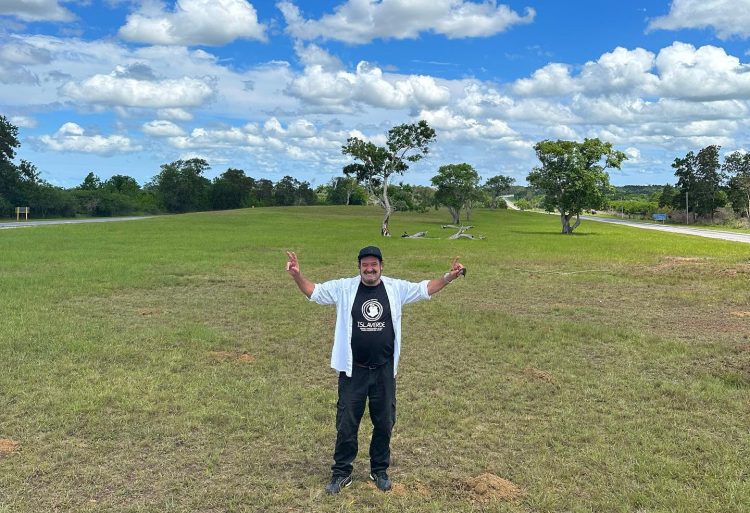
With his environmental passion, Jorge Perugorría would be bringing Isla de la Juventud closer to adding another to the exuberant and long list of names of the special municipality.
Isla Verde? Why not?
Before, it was, ephemerally baptized, San Juan Evangelista, as Christopher Columbus called it on his second voyage when he arrived on its coast in June 1494; Santiago, a proposal by Diego Velázquez; Santa María, by royal order; Ahao, stipulated by King Ferdinand the Catholic in 1525, based on a calligraphic nonsense that his ignorance did not amend.
There is more. San Paulo or San Pauli, according to the Italian cartographer Maggiolo. Isla de Pinos, according to statements by the Grand Admiral’s servant, the Portuguese Juan de Salcedo, referring to what the sailors said when admiring the copious coniferous forests.
Likewise, there is also Guanaxa, a mere confusion with an island of the same name in the Gulf of Honduras; Reina Amalia, in homage to the third wife of Fernando VII, and Camaraco, derived from the indigenous voice Camarcó, an indigenous town on the left bank of the Arimao River, in the central-southern province of Cienfuegos.
Outside of the official or unofficial geo-nomenclatures, historiography and literature listed some other must-sees:



Isla de los Piratas, for being a busy base for privateers and pirates, smuggling trade and illicit extraction of natural resources; Treasure Island, for all of the above plus the novel of the same name by the Englishman Robert L. Stevenson; Isla de las Cotorras, given the former abundance of such chattering parrots; and Siberia de Cuba, for being a wasteland for political deportees during the Spanish colonial regime.
In the 1930s, a political prisoner who would later die for the Spanish Republic, Pablo de la Torriente Brau, called it La isla de los 500 asesinatos, in reference to his experience in the Model Prison, from which he wrote carnal reports about the violence of the dictatorship in turn.
Isla de la Juventud, not so much now
Of all the nominations, Isla de Pinos persevered. It wasn’t forever. A Babelic educational program inaugurated in 1977 with thousands of students, mainly African — although there were also Mongolians and North Koreans — moved Fidel Castro to rename the 2,419 square kilometer territory, then covered in citrus fields in a sort of Eden of the Global South.
Then, as decades passed, some of the African political cadres who have been or are Cuba’s interlocutors graduated from those schools as high school graduates. Others studied university degrees in the Caribbean country. For many, those efforts were an investment in the future.
Since 1978, and until now, the territory, located about 170 kilometers south of Havana and with just over 80,000 inhabitants, has enjoyed lexical rest.
There are no more citrus trees, nor are there any foreign students (who reached close to 20,000), but its splendid nature remains, which the famous actor, director and plastic artist Jorge Perugorría intends to turn into his best work outside the sets: an ecological laboratory that is paradigmatic in the insular Caribbean.
“We believe that projects related to sustainable agriculture can be developed and stimulate entrepreneurship and sustainable tourism on the island, which has all the conditions for it,” said the actor, 59, during a press conference this Friday at the Gorría Gallery Workshop.
The property is a LDP, Local Development Program, authored by the activist to promote the plastic arts in the San Isidro neighborhood, a port community and former brothel associated with one of the city’s black legends: the pimp of Italian origin Alberto Yarini, killed by five bullets in 1910.
The EU factor
Perugorría insists on the benefits of Isla de la Juventud: 60 diving spots in its shallow and clear waters, migratory bird watching, hiking, a nature reserve (Punta Francés Natural Park) that occupies half of the territory, but also turns the reflector towards large areas, formerly citrus crops, now vacant and colonized by marabú. “There you can develop sustainable agriculture projects,” he reiterated.
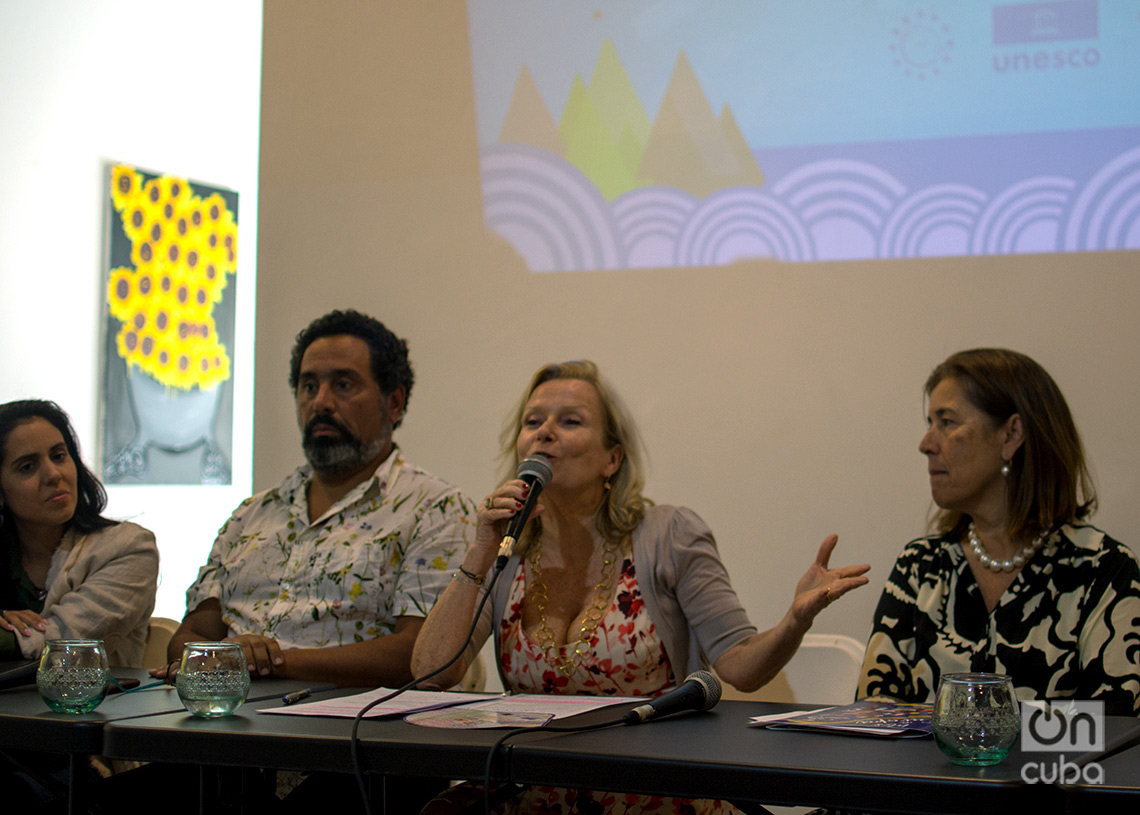
Catapulted to international stardom for his role in the iconic Fresa y chocolate (Strawberry and Chocolate) (1993), the actor “profoundly” thanked the European Union and its Member States. Through UNESCO, several of its embassies and the Transcultura project have provided decisive assistance to carry out the second edition of the Isla Verde festival, which becomes part of the program of activities for the Month of Europe in Cuba at this time.
“We are very happy to have the help of the European Union, because the objectives of the festival are politically aligned with issues defended by the EU, such as the fight against climate change,” Perugorría said during the conference.
The development of creative industries appears in the DNA of the event, as part of the horizons of the private sector, “to support and raise awareness among young people through talks, the environmental education system, lectures, workshops, tree planting. Everything that the festival already did is aligned with the objectives of the EU,” added the founder of the Isla Verde project.
His words were followed closely by the EU ambassador in Cuba, the Portuguese Isabel Brilhante.
“With the first edition a seed of collaboration was sown. This is a project to which one cannot remain indifferent,” said Brilhante, whose diplomatic career has taken her to African countries and Venezuela, expelled from the latter during one of the outbursts between Caracas and Brussels over the imposition of community sanctions.
The official confirmed the European interest in promoting sustainable development on the Isla de la Juventud, through the use of renewable energies and the incorporation of local children and youth to such a project.
“They are priorities for the EU and we are very pleased with this initiative and we are all very committed to making it successful,” said the ambassador.
For her part, Anne Lemaistre, director of the UNESCO Regional Office of Culture for Latin America and the Caribbean, established in Havana since 1950, spoke of the convenience of “this fruitful alliance” to “promote knowledge about environmental education and also involve young people in an artistic way.”
The French expert praised the Transcultura program for young entrepreneurs aged 18 to 35 whose goal is to launch creative cultural industries connected to cinema, fashion, music and other art manifestations.
In the second edition of Isla Verde, UNESCO will install film-making, photography and environmental journalism workshops, in addition to the screening of short films related to the climate issue.
“There will be workshops about school gardens and the fight against plastic, as well as talks on the circular economy,” explained Lemaistre, previously head of the UNESCO office in Cambodia and the Ivory Coast.
Depth charges
One of the depth charges of the Isla de la Juventud event are the lectures that will be given by two outstanding members of the IPCC — United Nations Intergovernmental Panel on Climate Change — which in 2007 was awarded the Nobel Peace Prize, along with former Vice President of the United States Albert Arnold (Al) Gore Jr.
These are doctors Diana Ruiz Pino, Colombian oceanographer and climatologist, pioneer in the study of the evolution of CO2 and ocean acidification, related to the environmental impact on marine ecosystems; and Ramón Pichs Madruga, an expert in economic sciences, who in 2023 was elected vice president of the IPCC, during its 59th session in Nairobi, Kenya.
Another attraction will be the exhibition of the results of the coastal survey of Cuba carried out in 2023 by an interdisciplinary group of Cuban and foreign scientists aboard the vessel Oceans for Youth.
The experience, carried out more than 500 years after the first circumnavigation of Cuban geography, which occurred in 1508, evaluated the current conditions of the coral reefs, while recording data of interest for various investigations.
“It will be the first activity of this type for a children and youth audience,” announced, for his part, Yosiel Marrero, environmental engineer and director of the Economy and Responsible Consumption Program of the Antonio Nuñez Jiménez Nature and Man Foundation.
A cinema proposal will reach 4,000 children and teenagers with some of the films that are in competition at the festival, announced, for her part, Shaima Legón, responsible for the educational programming of the event.
“They are films that have been carefully selected by scientists and methodologists to give children environmental education,” explained Legón.
Plastic arts, traces of luminaries
Sachie Hernández, curator and director of a visual project that is being incorporated into the Isla Verde contest for the first time, noted that unlike the first edition, for this second edition about 25 artists will arrive, mostly Cubans from different generations and some residing abroad, many of whom “responded above our expectations.”
Among them, she cited Alexandre Arrechea — Jaca —, former member of the artistic collective Los Carpinteros; Antonio Eligio Fernández — Tonel — professor of Visual Arts and Theory in the Department of Art History at the University of British Columbia, Vancouver, Canada; and Wilfredo Prieto, today the most famous conceptual artist in Cuba and author of the Vaso medio lleno, a piece that caused a stir due to its price of 20,000 euros.
To further enhance the event, European creators will also attend, including the Icelandic-Danish Olafur Eliasson, known for his installations that investigate the human experience, for better or worse, in the world of nature.
In 1999 the 57-year-old artist photographed several glaciers in Iceland. Two decades later, in 2019, he decided to photograph them again, creating a response to his original series of glaciers, which exposed the dramatic changes that had taken place due to global warming.
“They will make interventions and those works will remain on the island, as part of its heritage, to accompany the visual journey of the Isla de la Juventud inhabitants,” the curator said.
The works will be exhibited in two spaces. In the courtyard of the Municipal Museum and in the Model Prison, under the invocation of a provocative title: De la isla a la Luna.
“A group of primary school children will reflect their fantasy in a mural connected to interplanetary travel, because Isla Verde is like a great utopia,” said Hernández Machín, former director of the Servando gallery in Havana.
Films in competition
The event, chaired by Perugorría, examined almost a hundred works presented, after which an official selection in competition was made up of 30 audiovisual works from 15 countries.
In accordance with the newly named 2024 National Film Award, the selection committee chose 10 feature films and 20 short films to participate in the competition.
Both genres will have a jury made up of figures from the national and international seventh art, as well as researchers and scientists.
The contest will present the Isla Verde awards, which recognize and celebrate personalities or projects dedicated to the conservation, study and protection of the planet’s environment.
The Cuban participation is divided into six documentary works, two long and four short. The issues addressed are connected, among others, to the reproduction of corals (Bajo la luz de la esperanza); sustainable beekeeping (Abejas cubanas: La revolución orgánica) or the making of personal accessories from recycled material (Mou).
In the foreign offer, the thematic arc goes from the expected to the unexpected. Sample buttons? In the Argentine documentary Nalá it talks about an urban chieftain; in the Brazilian Haiku aislado — montaje del director, experimental in nature, Japanese Haiku poetry is related to natural landscapes; while Lui is a Peruvian cartoon that follows the vicissitudes of an endangered hawksbill turtle, from birth to adulthood.
For those who like fiction and environmental thrillers, the festival has La promesse verte, a French film by Édouard Bergeon, from 2023, which recreates the story of a mother who will try to save her son condemned to death in Indonesia.
Driven by that purpose, she launches herself into an unequal battle against the palm oil producers, responsible for deforestation, and against the powerful industrial lobbies.
A full stop with Dr. Marrero
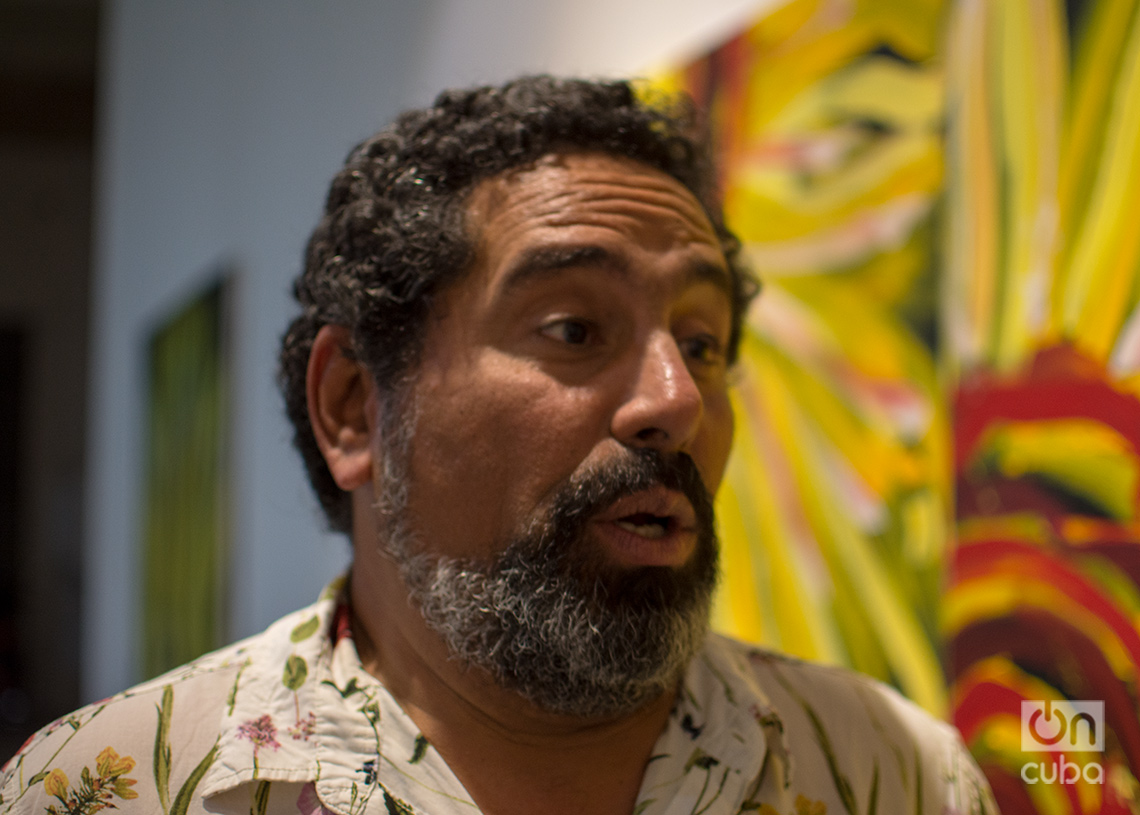
From the point of view of the Núñez Jiménez Foundation, how do you perceive the fact that an undertaking of cultural scope, fundamentally cinematographic, raises the environmental issue in Isla de la Juventud? Do you consider that this territory has been somewhat forgotten by Cuban ecology and environmentalism?
For a long time, the environmental issue was forgotten and relegated in the world in general, and in Cuba we had the Soviet heritage — which was also a world heritage — that nature was there to serve us.
That concept has been changing and therefore within Cuba as well. The fact that a cultural undertaking is highlighting this issue has a very specific link with the primary intentions of Dr. Antonio Núñez Jiménez, who was a very ecumenical person, always willing to transmit knowledge.
Now entrepreneurship in relation to the environment is a topic that many institutions have, but the Foundation, since socioeconomic regulations changed in Cuba in 2010, has started to work with the private sector offering sustainable business workshops and we introduced, together with the Center for Studies on the Cuban Economy, the term corporate social responsibility, which we mainly put corporate socio-environmental responsibility.
The Foundation has given management tools before anyone else.…
Yes, and not for charity. We began to give all these small initiatives tools so that, from their business model, they have relationships with natural resources — especially with two of the most important resources, which are water and energy — and we teach them good practices regarding that.
Cuba is virgin territory in that regard, right?
Cuba could be a perfect laboratory to implement all innovative proposals in economic and financial issues, despite the impediments and existing regulations and over-regulations. There are some that are complied with, others that are not.
Do you fear that private entrepreneurship is a predatory agent of nature in its desire to maximize profits?
It is a risk that is always there…. There is a hopeful element and that is that there is a good percentage of ventures in the hands of young people who, from the moment they start, have an interest in environmental issues.
In November 2020, the Foundation held the first fair of environmental products, services and ideas that emerged in quarantine. And we were able to verify that there were many enterprises that, without having received training or major courses, were already considering the environmental issue in their resolve.
But, I repeat, it is a risk, especially when you want to do things big. There will always be the dichotomy between maximizing profits and managing natural resources responsibly.
And in the face of these risks, the Foundation does not fold its arms….
Of course not. Our commitment is that things are done correctly. The Foundation has been a pioneer in introducing blue economy concepts; of the green; of the brown; the silver one. This is what is called color economies. Given the demographic trends in Cuba, we must think about the economy based on the elderly, the silver one. Thinking about the resources and capabilities that these people may still have.
Do you think Cuba will finally conceive its own viable model?
Cuba has a historical context of the last hundred years that is different from similar countries in the region. Therefore, models of countries or societies cannot be imposed. Many refer to Asian, Chinese or Vietnamese models. The challenge here — and the economy-environment relationship will depend on this — is that we have to build our model. My next article is titled “Buscando un color para la economía cubana” (Looking for a color for the Cuban economy).
And what would that color be?
I have it, but I’m not going to tell you. Now then, the color will depend on the relationship that natural resources and economic growth have had at different stages in the last hundred years of the Cuban economy.
One last thing.… There is talk of the carbon footprint of the Isla Verde festival. Is it a real term, or an entelechy to calm consciences and allow help?
The carbon footprint is an interesting tool. It is not the most effective, but it can have high levels of effectiveness. In reality, in two words, it is an element of control and stimulation. Then it fulfills its function, because it controls you and commits you. Last year we did a carbon footprint measurement with the festival using a methodology from the Cinema Planeta festival, from Mexico, because they measure it, otherwise no one gives you any money. And each festival, after measuring its carbon footprint, has to sow.
That’s where El Bosque del Cine comes into play….
The Bosque del Cine, an initiative promoted by the Santander Film Festival in Spain to offset the carbon footprint of companies in the audiovisual sector, is giving us money from our own planting of pine trees in the first edition of the festival.
This year we will plant 3,000 coniferous plants. Even last year was not proportional to the carbon footprint we are generating. But it is not an entelechy, although it cannot be said that we cover all the expenses, it is a matter of commitment, control and stimulation, which is good to handle.
A green iceberg in the Anthropocene era
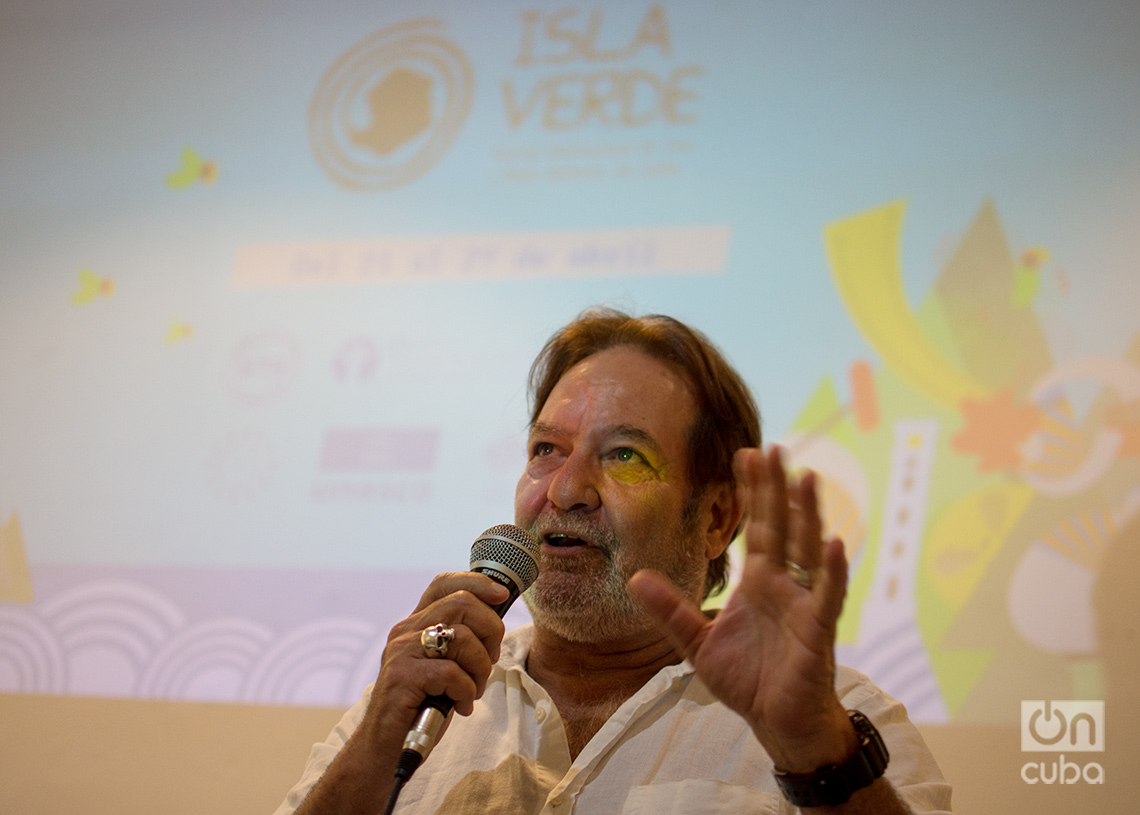
Optimism, which is a natural state for Jorge Perugorría, makes him see the qualitative leap from the first to the second edition of Isla Verde in just one year. And he certainly isn’t exaggerating.
“For this year Isla Verde is already a LDP, based on the Isla de la Juventud, which is the one that manages and produces this second edition. And the other difference is that this year will be competitive,” said the artist.
Perugorría also thanked the cloud of collaborators and sponsors of the event, including European and Latin American embassies, ICAIC, MSMEs, Isla de la Juventud LDPs, foundations such as Good Planet, festivals, such as the International Film and Environment of Mexico Cinema Planeta, and the international association Green Film Network, a network that brings together more than 30 environmental competitions around the world.
He also did not forget that the event program will promote Isla de la Juventud artistic talent and will hold gatherings for Natalia Bolívar (1934-2023), a figure as fictional as it is telluric in Cuban culture and politics; and Daniel Diez (1946-2023), the man who delivered unpublished images of life, most of the time difficult and lonely, in the mountains of Cuba, through Televisión Serrana, founded by him in the midst of the debacle of the 1990s.
Preliminarily, for Perugorría the most significant success of his project has been to legitimize private and service entrepreneurship by fusing it with the State’s environmental strategy.
These first tests can be seen as a kind of iceberg that only shows a minimum of what can be achieved in the medium and long terms, through a laboratory that combines unprecedented forms of management in a field as dynamic and decisive as the environment in the age of Anthropocene.
The actor, meanwhile, promised to end the opening session of the festival on April 21 with “everyone dancing sucu suco,” the contagious vernacular rhythm of Isla de la Juventud.
And for the closing, on the 27th, the president of the Festival wants to play with surprises. In the middle of a great concert on the grounds of the Presidio Modelo with David Torrens and Polito Ibáñez, as hosts, some soloists and groups will burst onto the stage, whose identities remain secret.
For now, the second release of Isla Verde has its own soundtrack. The song, which is titled the same as the contest, has been composed by Torrens and Kelvis Ochoa, and is performed by both, plus Isaac Delgado with the backing of his fantastic band to the rhythm of sucu suco. What else but that.






