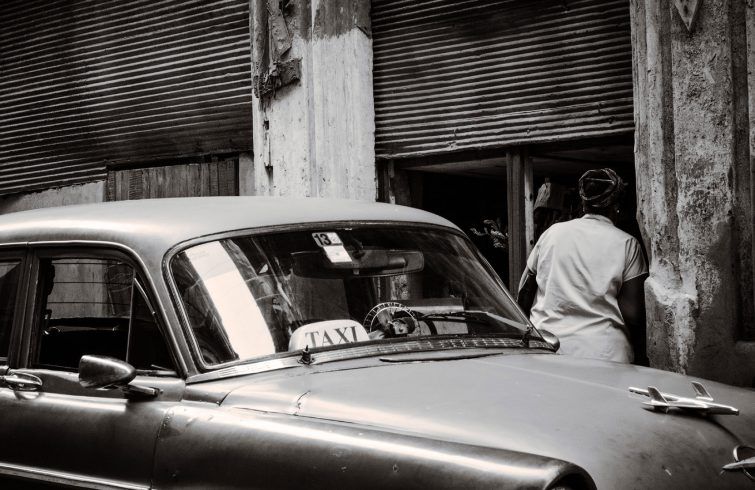




It is said that between 60,000 and 75.000 more than 50 year-old cars circulate in Cuba, although the figure is not official. Armando’s 1956 Plymouth; Alberto’s 1957 Windsor Chrysler; and Ricardo’s lowest and refined Austin-Healey surely form part of those numbers on the means of transportation that Cubans haven’t been able to stop using.
The island is a museum in motion because of the vintage cars that transport millions of Cubans and visitors every day, while in other places in the world they are exhibition pieces or luxuries for sporadic outings.
Cuba is a repository of Chevrolet, Ford, Cadillac, Jaguar or Dodge cars, the previously mentioned trade names, and also some from the extinct socialist camp: Lada or Moskvitch. But American cars mark the tendency in the Cuban auto park. Cubans baptized them as Almendrones, supposedly because many of them share a certain resemblance to an almond (in Spanish almendra is an almond, thus the name of almendrón, meaning a big almond).
That’s why Armando spends days fixing the faults in his 1956 Plymouth. The estimate is difficult, since just on trips to the airport the old car gobbles up thousands of kilometers a month. Repairing it, being on the lookout for noises so that it is trustworthy and docile, and afterwards transporting the clients, is his day-to-day routine.
“This car is my life and that of my family. Most of the parts are not found, the only way to keep it running is adapting them, using parts from other cars. That’s why I changed the engine. There aren’t many original cars left,” he says.
The 1956 Plymouth seats six and reaches more than 100 km/h on the Havana-Pinar del Río thruway. To keep it running, you have to be a driver and a mechanic, a duality that the owners in Cuba learn almost by force.
Armando has lived off of American cars for almost two decades. He started off with one that was rundown and half rotting. He transformed and painted it, changed the engine and afterwards sold it for double its price. That’s how he began his journey as a mechanic, botero (as the taxi drivers of vintage cars are known in Cuba) which made him go on to change cars.
He goes over how many he had, later another would come and then another. He repaired and sold them with greater comfort and better engines at a higher price than the previous one. For the time being, his list stopped at 17 transformed cars.
Now he has two: the modern and the old one. He distributes them according to the destination and the duration of the trips and other things, like the state of the highways. But he would like it if someday all his cars were modern.
“The thing is that it’s already easier to find parts for the modern ones. The old ones I keep out of necessity, but it will never be the same. They are valuable because they attract the attention of foreigners, but without help it’s difficult to conserve them,” he says.
For the time being the 1956 Plymouth is his family’s sustenance.
Classical and Vintage Car Club: “A lo Cubano”
“A lo Cubano” will be celebrating its 15th anniversary in October. It started off as an adventure in 2003 and it already has some 140 members, most of them with cars that have more than 60 years of exploitation. The requirement to be a member is to have vintage cars, “but there are also people who are fanatics and don’t have a car and come to the gatherings,” says Alberto, its president. American cars also predominate here.
“They are called almendrones, and sometimes in a pejorative way, especially those who don’t own a car. But a car is like having children. The club’s activities are family gatherings,” he says.
In Cuba there are two levels of American car owners. They are invisible barriers conditioned by the cars’ quality and the principal market they work with. The care, conservation of the cars that resemble the most the original ones usually varies among these.
The taxi drivers who work for national passengers charge in national currency or in CUC, with routes in the cities or interprovincial trips. These American cars usually suffer more transformations than the others. Some of them have bodywork extensions to increase the capacity and increasingly distance themselves from what they once were.
But there are those that work directly with foreign tourists, like many of the members of the “A lo Cubano” Club. Their cars are better conserved, have greater comfort and their owners mainly move in the tourist areas.
Both worlds, indispensable to understand transportation in Cuba, are part of that image of the island perceived abroad. Many visitors come looking for these relics. They always ask, among other things, about the price and how original the cars are, Alberto explains. In addition, they ask to visit the workshops where they are saved from destruction, at the risk of changing their essence.
“The cars have lost a lot of originality depending on logical things: if the parts are fount or not; if the diesel engine is more economical than the gasoline one; or if the engine is very old. When your incomes are good you can decide if you leave it original, but if you have a single car and your resources are not the most appropriate, you have to adapt and give it the engine of another car or change the brakes.
“That means that it will not look nice. It frequently gives the car greater value. It is a car that mechanically runs well, with a good appearance, with more adaptations. We are a case apart in the world due to how difficult it is to get parts, although it is no longer so difficult because now they bring them from Florida and the cars can be restored,” he says.
According to Alberto, in the history of vintage cars in Cuba there have been three stages that have defined the fate of these cars. Before the Cuban Revolution and when relations were broken with the United States, the island had one of the world’s highest indices of cars. “U.S. companies tested their cars in Cuba…. The Americans came to buy their cars here,” says Lupe Fuentes, in charge of the Club’s public relations.
But American cars and from other countries stopped being imported to Cuba in the 1960s. It was the start of the second stage. “Here’s where the inventiveness of the mechanics, the toolmakers and auto bodyworkers starts. They continue without resources, parts from one car are changed to another. It is the time of survival: a nice stage but with consequences. We never learned to value what we had at hand, we always noticed more on how good it would be to have a modern car,” Alberto explains.
The third one, he affirms, was marked by the boom in tourism. “With the arrival of tourists many people realized the value of these cars in the rest of the world. They are also the cause of attraction to travel to Cuba,” he adds.
In addition, for Alberto his 1957 Windsor Chrysler is his life, his family’s sustenance. He invests time and money in maintaining it up to date not only because of this but also because “it is part of the history, of the heritage of the Cuban family.”
He explains that around them an industry has been created that links them to the national economy and history. “Thousands of families live off of that: from the driver, the mechanic, the toolmaker, even the car washer.”
Vintage car mechanic
Ricardo Medel dedicated many years to rebuilding his Austin-Healey, a beautiful British car. He almost did it completely and was able to recover its initial splendor. Medel is well-known as a Cuban vintage car maestro.
On the island, he says, “there were cars of all the trade names, even European ones. Afterwards many were dismantled for spare parts.” Maintaining the cars set in motion Cubans’ inventiveness, something that was taken to many other fields. “Not only parts were made but also tools to work. They were made and adapted.”
Mechanics and drivers forged a brotherhood around vintage cars and the shortages. They exchanged parts and solutions to the most diverse difficulties in order to maintain their relics. With the boom in tourism, explains his wife Lupe, the awareness about conservation has even reached those taxi drivers who charge in national currency. An aesthetics culture is being developed, something that already existed among those who work with foreigners. “They have been trying to improve their cars. They learn English to relate with the foreigners, because vintage cars are part of Cuban heritage, one of the images that represent Cuba abroad, which is attractive for visitors,” she says.
Ricardo notes that, with the entry of modern cars to Cuba the auto park is being renovated. Some assess the purchase of a new car as the possibility of improving, something that could condemn the old ones to disappear in a perhaps distant future.
“Many are tired and think that having a modern car will make life easier for them. But here they are going to fall into another trap, because Cuba is still not prepared for that until the day in which the entry of new cars and new parts are allowed, brought over by the same individual. Others will have the awareness to continue maintaining them.”
“Or they will become collection cars,” Lupe adds.