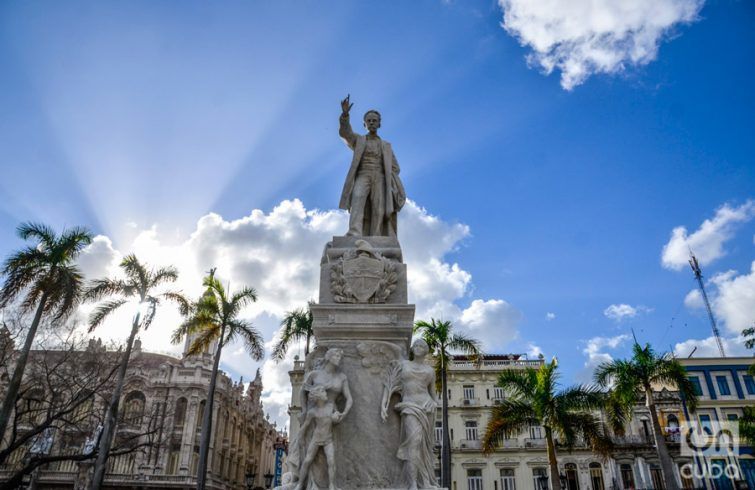



Whoever has read Martí’s immense journalistic work and is capable of taking it in in a single act of internal visualization will understand that he is as close as possible to having a human idea of Creation’s vastness. The vision that has been capable of seeing or imagining with so much precision that enormous mass of circumstances, events, characters, spectacles, dramas, disasters and alleluias of human beings, that monstrous royal parade that Rimbaud symbolically reduced in one of his “illuminations,” that incomparable mirror of the planet’s world life during the 10 most intense years of Martí’s journalistic activity, is a vision that – like that of Shakespeare, Goethe, Whitman or Claudel, but not applicable to imagination but rather to reality – in some way humanly represents what we conceive as omniunderstanding and avenging characteristic of the Father. It is presided over by a double sign: the scale in the trial; the expansion in the impulse. Like the paternal sun, which comes out for the good and for the bad, giving them all the same opportunity to excel and redeem themselves, magnanimously illuminating all of them in their sins and in their virtues, thus Martí’s vision as a journalist – in his Escenas norteamericanas y europeas [North American and European Scenes] – is the greatest example we know of the capacity to assume the world in justice and truth, without fanaticisms of any kind, although not, of course, without a very personal viewpoint which aspires to be that of humanity itself in its best essence. As he says to Mitre in the program letter of these Escenas, a “faithful seer” is what Martí wants to be in them: a seer in the needle of the compass, in the maximum of justice and understanding accessible to a man, and in this case a man that is not ideally contemplating men, but rather participating in their deepest struggles. “About myself,” he adds, “I only give my love to the expansion – and my horror to imprisonment – of the human spirit. All that revolves on that axis.”
If from that world we descend to Martí’s intimate kingdom, which is expressed as convulsed strokes of blood in his letters, in his verses and at times in his speeches and articles in Patria, to that of the “tremulous and lonely soul,” to that of the “terrified fallow deer” and of the “wounded deer,” to that of the “broken Christ,” we will confirm that neither did anyone in his time, outside the paths consecrated by the diverse religious creeds, identified in such a way with the suffering, compensating and redeeming spirit of the Son. Here the sign is no longer the scale but rather the cross; or rather the scale has turned into a cross, because the suffering is prevailed by the mystery of equity, by the passion of a balance that is a form of justice, of a justice that is the daughter of sacrifice. Just like Anaximander sensed the ontological value of justice in the balance of the physical world, because things “make reparation and satisfaction to one another for their injustice according to the appointed time,” sacrificing each thing for the others so that all of them exist; just like Heracleitus discovered the dialectical value of the measure and the contradiction in the symbol of the “arc and the lyre,” Martí incarnated these ideas in the daily battle with men and the hostile forces of history. He did not start off by predicating moderation and equity, but rather he imposed them on himself in the midst of the storm of passions that as a man and fighter were battering him, in the midst of the indignation that continuously shook him. But he was fair, almost like a god, with his enemies: with Spain, with the autonomists, with the United States. And, almost like a god, he was alone among his friends. Because solitude is the sign of the cross and that of Martí, which was the cross for the world’s pain, started being nailed with the Presidium’s shackle, ended with the bullet in Dos Ríos, in the cross of veins of water where he fell; until our days he continues being the topmost example of human solitude that we know of. “In the letters to Mercado, particularly in those of the terrible year of 1886,” writes Martínez Estrada, “he has exhaled the howl of a cornered, wounded wild animal, chased to the corner where he had sought refuge to die. This image is repeatedly found in his confidential writings. That lament, that howl that is lost without an echo is terrifying and helps us to discover the depth of that solitude which was of persons, ideas, affections, things and casts a pall over more than half of his life.” And Diego Vicente Tejera, mysteriously tripling the adjective, testified: “That’s how he has made this revolution that astonishes us, working during long years alone, alone, alone.” Didn’t he say in his prophetic prologue: “Per chance like in the human all progress consists in returning to the point of departure, is it returning to Christ, the forgiving, captivating, crucified Christ, the one that is barefoot and with open arms?” Wasn’t the cross made from shells by the women workers of Key West the present he loved the most? Didn’t he say at the end of his Way of the Cross, in his letter will, that “one has to learn to die on the cross every day”? Weren’t his last words in the battlefield: “I will let them nail me to the cross for Cuba’s cause”? He was alone and heartbroken, more than ever, during his last days; alone and heartbroken he continues being for his people: an earthly, historic, profane image but on the holy limits, of he about whom was said: “He came to his home, and his people did not receive him.”
And what’s strange that it was thus, that it thus is, if that is always the fate of he who truly participates of the Spirit, “which the world cannot receive, because it doesn’t see or know him”? But these men who represent the holy in the profane, whose paradoxical, tragic destiny is to be guides, maestros and apostles must give testimony and be tormented in the world, because to a certain extent they represent the Spirit whose mission, as it is said, is to teach us all the things and remind us of all the things and guide us toward truth. And thus Martí, we know not how, was spontaneously called Maestro and Apostle. They all knew he was taking them to battle, but did not call him Chief, Captain, Caudillo, Generalissimo, but rather Maestro and Apostle, because they knew that his principal mission, even in the midst of the battle, was to teach and predicate. And his main gifts were language and charity. Because of the fire and the strangeness, because of the multiplicity of registries and the ability to touch each one in their heart, Martí’s oratory came from the mystery of the Pentecost. The gift of languages is not only the word glossary, the faculty to speak unknown languages (that phenomenon so astutely interpreted by Cecil S. Lewis), but rather the grace of being able to speak to each one in their own language. Actually, many humble men from his time must have had the impression that Martí was speaking an unknown language, but at the same time they felt that for the first time someone was speaking to them in their mother tongue. That double, simultaneous truth is the one that is exactly contained in the genius exclamation of an old Mambí fighter: “We didn’t understand him, but we were willing to die for him!” And if they were willing to die for him it is because his gift of languages was none other than an overabundance of his charity, manifested in his oratory, lifting men to their highest level, going straight and secretly to their heart.
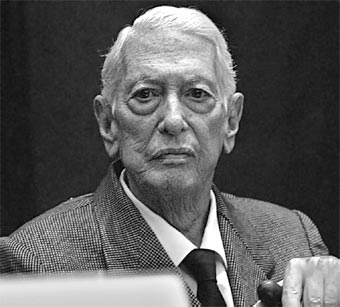
Citio Vitier was a Cuban narrator, essayist and critic. Considered the major figure of Cuban erudite criticism. Renovator of Cuban national novel writing. Great connoisseur of José Martí’s work. One of the most significant Cuban writers of all times. Possessor of a vast published work that includes poetry, essay, narrative, criticisms and translations.