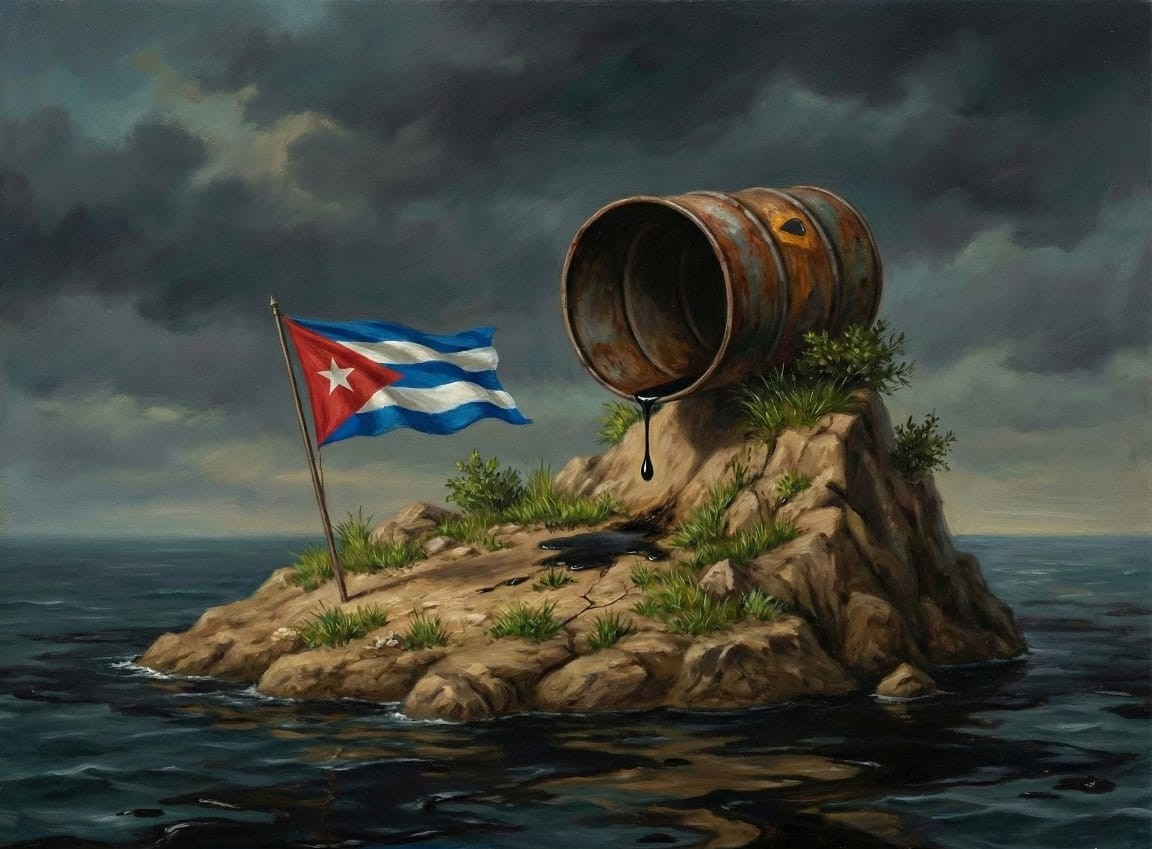
The situation in Venezuela has become the determining factor for the Cuban economy in the short term. Relations with the South American country have been key to Cuba’s economic stability, especially in the energy sector. So much so that, despite having reduced its historical shipments in recent years, the Venezuelan supply remains crucial.
Despite the terrible power outages that affect homes and businesses daily for several hours, Venezuelan oil, combined with domestic production and other external sources of fuel, still guarantees the minimum vitality of the economy and society.
I recently spoke with a friend about this situation, and in a “zero fuel” scenario he told me something true: the last five years will seem like paradise compared to what awaits us. This is not the time to be alarmist or predict catastrophes, but the circumstances require extreme pragmatism.
Cuba: internal and external sources of crude oil
Cuba consumes around 120,000 barrels of oil per day (bpd), according to calculations based on an interview with the Minister of Energy and Mines published in the Granma newspaper in March 2025. Of these:
- 33% is from domestic production (40,000 bpd). After 13 years of decreases in domestic crude oil production, the state-owned company Cubapetróleo (CUPET) exceeded its production target last year, covering one-third of the country’s demand.
- 67% comes from imports (80,000 bpd), which makes Cuba an economy highly dependent on fossil fuels produced in other parts of the world. The main suppliers are Venezuela, Mexico, Russia and, to a lesser extent, Angola, Algeria or Brazil.
In October 2000, Cuba and Venezuela signed a Comprehensive Cooperation Agreement. The island obtained very favorable terms to receive 53,000 bpd in exchange for medical, technical and professional services.
At its peak, between 2009 and 2012, Venezuela sent up to 100,000 barrels of crude oil daily. Starting in 2013, coinciding with the deterioration of the economic situation in the South American country, the supply began to decrease progressively.



In 2025, Venezuela sent between 27,000 and 35,000 bpd to Cuba, according to various sources. Although the decrease is significant, this amount still represents 22-29% of the demand that the Cuban economy needs to function “normally.” At the end of the year, the U.S. blockade of Venezuelan oil tankers interrupted the flows to Cuba.
What could happen?
So far, the Chavista government remains in power, has guaranteed administrative continuity and is showing internal unity, even with massive popular demonstrations. However, it faces undeniable pressure from the United States.
We cannot lose sight of the fact that Venezuela is being threatened by the most powerful nation on the planet. As if they were dominoes, the U.S. president has declared his intention to cut off all “money and oil” coming from Venezuela to bring down Cuba.
At such a critical moment, what scenarios could we face?
- Improbable scenario: everything returns to “normal.” With the lowest probability of all, the United States would lift the oil blockade on Venezuela and allow — or turn a blind eye to — shipments to Cuba.
- Probable scenario 1: partial and progressive reductions. Even if the Bolivarian government were willing to maintain its energy commitments with Cuba, it would face persecution and pressure from Washington. This hostility could manifest itself in a combination of more military threats, continued seizure of Venezuelan fuel tankers and diplomatic pressure.
- Probable scenario 2: total cutoff. In the worst-case scenario for the Cuban economy, we would lose our primary supplier of fossil fuels, with even more devastating consequences for the Cuban economy.
None of the three scenarios is ideal. We are talking about an economy that, for years, has been surviving on a quantity of fuel below the minimum it needs to operate normally. Therefore, the critical aspect of the situation is that Cuba cannot afford to do without a single drop more of oil.
And what about other suppliers? Although not impossible, it does not seem likely that Mexico, Russia and other countries that currently supply fossil fuels to Cuba will compensate for the partial or total loss from Venezuela.
The Mexican president confirmed that her country will maintain current flows in the present circumstances, but without further increases. For his part, Putin’s reaction came last week at a meeting with ambassadors where he said that “…we have always provided and continue to provide assistance to our Cuban friends,” but this is more of a diplomatic statement than a confirmation of an increase in Russian aid.
Is there room to negotiate with new suppliers? The Cuban government is probably evaluating options, but the problem lies in the shortage of foreign currency.
Cuba does not have enough foreign currency income to cover not only the needs for electricity generation, but also for basic food, medicine or public transportation. Beyond the U.S. embargo, which effectively closes markets and scares away investors, the country is unable to generate dollars.
We all hope for the best for our country. However, as José Martí wrote in September 1893: “The whole art of salvation lies in foresight.” It is entirely rational — and responsible — to plan for the worst-case scenario. The government has the official figures on the precise scope of each of the projections, which in all cases increase the complexity of the current situation.
Exposed vulnerabilities of the Cuban economy
Undoubtedly, the current crisis in Venezuela and its consequences leave us with clear lessons about how the Cuban economy functions in the energy sector and its relations with the rest of the world:
- The dependence on fossil fuels is extremely high. Cuba depends on oil and other fossil fuels for 91% of its power generation, which demonstrates the critical need for high and sustained flows. Requiring the import of two-thirds of national demand, energy relations with other countries are strategic.
- Crude oil imports are relatively diversified. Unlike the almost total dependence on the Soviet Union before its disintegration, oil demand relies on several international suppliers. A partial or total cutoff from Venezuela does not mean the cessation of all flows from abroad, although it does affect the most important one. The problem is that this “relative diversification” does not meet the current minimum needs of society and the economy. The solution would involve: 1) increasing domestic crude oil production, 2) increasing shipments from current partners, 3) seeking new partners or 4) advancing the energy transition. All four solutions require significant amounts of foreign currency that are not available.
- The solar panel strategy is correct, but still insufficient. Investment in renewable energy sources is a strategic bet. 37% of investments in the state sector are dedicated to the supply of electricity, gas and water, resulting in the installation of 37 solar parks in one year. It is a commendable effort, but the reality is that power outages during 2025 were worse: not because the panels are ineffective, but because what they generate does not compensate for the growing deficit of fossil fuels. Renewable energies cover 9% of the current energy matrix. Cuba plans to increase that proportion to 24% in four years, so dependence on crude oil will be a structural problem for a couple of decades more.
- The sluggish reform has made us more vulnerable. The postponement of structural changes in state-owned enterprises, productivity, acceleration of foreign investment, the exchange market and better rules for the private sector has led to constant deterioration of economic activity, making us more vulnerable to external shocks.
- The U.S. economic war is at its peak. As in the worst moment in the 1990s, when the Helms-Burton Act was signed, now from Washington there is a deliberate and public intention to strangle the Cuban economy and provoke the expected regime change.
In conclusion, the crisis in Venezuela affects us directly. The combination of high dependence on imported fossil fuels, severe currency restrictions and an economic reform that has been postponed for more than fifteen years has minimized our room for maneuver. Relying solely on a change in the international context — whether in Washington or Caracas — is not a sound strategy. The extraordinary urgency of the current situation demands extraordinary boldness.