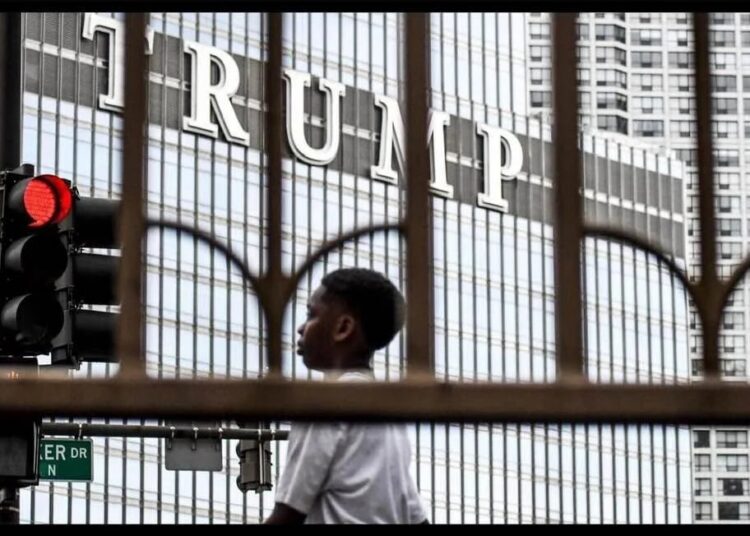
A document is circulating that reads like a movie script, but it is a national security report: one hundred pages dedicated to demonstrating that, since 1959, everything that has moved to the left in the United States—the Black Panthers and the mothers of the aid caravans, Angela Davis and the unions, Black Lives Matter and public defenders—was, in essence, a Cuban operation.
A blockaded island, with nothing to celebrate in its economy, with endless blackouts, supposedly governed the internal affairs of the world’s leading power for seven decades.
The joke writes itself, but it is not innocent. The document fabricates a racial inside enemy, transforms domestic dissent into foreign treason, and lays the groundwork for treating citizens as agents of a hostile power. That gesture has a name, a history, and its own filmography.
Tradition has called this procedure—not necessarily the regime that employs it—fascism. Its foundational film in the United States premiered in 1915.
The film is a poisoned masterpiece. D.W. Griffith’s The Birth of a Nation codified both the modern feature film and the grammar of American racial panic. There, emancipated Black people—played by white actors in blackface—threaten civilization while the Ku Klux Klan rides to the rescue as America’s redeemer. Wilson screened it at the White House. The Klan was dead, but it was resurrected that same year by the film and grew to number in the millions.
A century later, in 2016, Nate Parker filmed another The Birth of a Nation, using the same title as a counterpoint: the story of Nat Turner and the 1831 slave rebellion. Parker placed African Americans at the center of the story that the first film portrayed as a threat. Where Griffith saw danger, Parker saw the subject. Reality is not what is seen, but what and how it has come to be.
The report I am discussing is a third remake, and it stems from Griffith’s version. The document embraces the kinship. Its genealogical chapter is titled “Birth of a New Left.”¹ Its narrative operation is similar: the Black people protesting are not citizens with grievances spanning four centuries: they are “internal colonies” activated from Havana.
The irony is at a grade school level: that category wasn’t invented by any Cuban barracks, but by the Black radical tradition itself, which had been developing it since 1962, when Harold Cruse described Black Americans as a domestic colony. The report knows this: it quotes Carmichael. But it writes that Carmichael “told the audience in Havana.”
In the following paragraph, the act of saying it is already considered a cause: Cuba supposedly played a role “in the formation” of that consciousness. One of the pieces of evidence presented is a jeep ride driven by Fidel Castro.
With that same logic, the protests over the murder of George Floyd didn’t stem from a knee on a neck for nine minutes: they arose from something that, the report says, “can be linked, in one way or another, to Cuban influence.”² It’s the old fantasy of the master: the slave was content until the agitator from outside arrived.
Let’s clarify some terms. Robert Paxton defined fascism as a “form of political conduct characterized by an obsessive preoccupation with the decay of the community, its humiliation or victimization,” which pursues “with redemptive violence and without ethical or legal limits, objectives of internal cleansing and external expansion.”3
Umberto Eco, who grew up under Mussolini, listed the fourteen characteristics of fascism: among them, the fear of difference, “the obsession with conspiracy,” the enemy portrayed as “at once too strong and too weak,” and a golden rule: “For fascism, disagreement is treason.”4
Hannah Arendt had described the key figure of this mental regime: the “objective enemy,” guilty not for what he does, but for what he is. And she added a phrase written for the post-truth era: “The ideal subject of totalitarian government is not the convinced Nazi or the convinced Communist, but the person for whom there is no longer any distinction between fact and fiction, between true and false.”5
The report on Cuba belongs to this lineage: it cloaks the evidential apparatus—notes, chronologies, organizational charts—a fiction that cannot withstand the first contact with reality. Its strength lies not in what it proves, but in the “aesthetics of proof” it deploys.
For our century, Enzo Traverso speaks of post-fascism: movements that win elections and speak of freedom, but retain their hard core.6 Finchelstein draws a distinction: “Populism is an authoritarian form of democracy,” which arose “as a postwar reformulation of fascism”; fascism is ultra-violent dictatorship.7
Read against this literature, the report checks off this list. The obsession with conspiracy lies in treating the entire American left, from 1960 to the present, as a tentacle of a foreign brain. The enemy, too strong and too weak, that is this “collapsing” Cuba, supposedly controls universities, city halls, foundations, and even the Democratic Party. Disagreement is considered treason when lawyers defending detainees are portrayed as a “prison escape force.”
Beneath that list lies an older structure, what the Germans of the interwar period called the Dolchstoßlegende: the stab-in-the-back legend, according to which a great nation is never defeated from without, but betrayed from within. The report modernizes it: internal betrayal is rebranded as foreign infiltration. Domestic discontent—four centuries of bitter grievances, an inequality that is about to explode—ceases to have domestic causes and becomes remotely controlled. Protesting a police killing is not exercising a right: it is obeying a master from overseas.
And communism? In the 21st century, it is not a bloc, nor an army, nor an international organization with a central command. Put simply, it is practically nothing. To be somewhat serious, it is the memory of 20th-century experiences. More seriously: today, the question is what we have in common in the face of a capitalism that produces obscene inequalities and climate catastrophe.8
“Race is the negation of the idea of the common,” writes Achille Mbembe.9 Put that way, it is what communism could be in the 21st century. Nothing to do with what that document states.
As an aside, the dismantling of race as a political category has, among its classics, a Cuban: “There is no hatred of races, because there are no races,” wrote Martí in “Our America”; “the petty thinkers, the armchair thinkers, string together and reheat the races of the library.”10 The report places the tradition that taught us to read race as a library artifact, of “false erudition,” at the service of power, the ringleader of a racial conspiracy.
To put it bluntly: the Cuban state deserves criticism, and plenty of it. It deserves it for the one-party system, for the repression of dissent, and specifically for the July 2021 protests, for the stifling of the independent press, and for an economy that expels its own population. This criticism has several legitimate avenues on which to express themselves. One of them is within a tradition with its own name: that of democratic republicanism, which defined freedom as non-domination, as not being anyone’s servant.11
On the island, this tradition is embodied in Martí, who envisioned a republic without despotism and without castes.12 This idea is incompatible with the one-party system, as it is with the concept of the internal enemy and lists of suspects. In any case, there and here, a nation that treats its dissidents as agents of a foreign master reduces them to the status of servants that republicanism demands be abolished.
The report doesn’t criticize the Cuban state: it uses it. It uses its real disasters as a pretext to persecute the American social movement. The Cuban catastrophe functions there like the Weimar unemployment crisis in the Munich speeches: rather than a problem to be solved, it is a license for pogrom.
The United States had already produced its own variant of this, and always avoided calling it by its name. McCarthyism—the blacklists, the oaths of loyalty, the careers destroyed by a signature on an old petition—was the American form of the fascist reflex: the nation as purity, the dissident as a foreign agent, suspicion as proof.
McCarthy announced in 1950 that he had “here in my hand” a list of communists at the State Department. The list changed numbers depending on the speech, because it never existed.13 Hoover extended the method with COINTELPRO, which sabotaged Martin Luther King, to whom the FBI sent an anonymous letter urging him to commit suicide.14 The report on Cuba cites, with cynical nostalgia, the Senate committees of that era as if they were neutral sources.15 They are not: they are its family tree.
Why is it so difficult to call fascism fascism in the United States? It is, at least, because of three safeguards.
First, exceptionalism: fascism is defined as something European, of boots and parades. If there is no Nuremberg, there is no fascism. Sinclair Lewis titled his 1935 novel, It Can’t Happen Here, a work in which a smiling demagogue installs fascism in Washington because no one believes it could happen there.16
Second, the “amnesia”: Nazi lawyers studied American racial legislation—those concerning second-class citizenship and, above all, those prohibiting interracial marriage, the harshest in the world—to draft the Nuremberg racial laws.17 At the Nuremberg trials, this legislation was not tried as an independent crime: the lead prosecutor was a sitting Supreme Court Justice who would take twenty-two years to repeal his own country’s anti-miscegenation laws. Acknowledging fascism at home would force us to recognize that, in part, fascism originated at home.
As Césaire had said, what bourgeois Europe cannot forgive Hitler for “is not the crime itself,” but “his having applied colonialist procedures to Europe.”18 Third, the Cold War trained public debate to always point “totalitarianism” outward—Moscow, Havana, Beijing—and never toward the next county, where a man, African American, of course, who had fled on a bicycle, is shot point-blank on the ground, with an officer’s knee on him.19 The result is a political language with a forbidden word precisely when it needs it most.
The recent record is explicit:
Charlottesville, 2017: torches, the slogan “the Jews will not replace us,” a woman killed by a car; the president declares that there were “very fine people on both sides.”
Pittsburgh, 2018: eleven worshippers killed in a synagogue.
El Paso, 2019: 23 dead in a Walmart, targeted for being Hispanic.
Buffalo, 2022: ten Black shoppers killed by a young man who cited the “great replacement” theory, the same one a star cable television host repeated in more than four hundred programs.20
Jacksonville, 2023: three African Americans killed by a gunman with swastikas on his rifle.
None of this was organized by Havana. It was organized by its own tradition: that of Griffith.
All fascist movements have invoked real, prior catastrophes to justify their rise. For Hitler, Versailles and the six million unemployed of Weimar were enough to ultimately lead to Auschwitz. Afterward, the same template was followed, albeit in anti-communist garb: Indonesia in 1965, with half a million dead; Pinochet, who used the inflation of the Popular Unity government to inaugurate seventeen years of torture; the Argentine junta, which seized upon the real guerrilla resistance as a pretext for the disappearance of the thirty thousand people whose whereabouts are being demanded by human rights organizations.
There’s more. The overthrow of Mosaddeq in Iran in 1953 was an Anglo-American operation that the CIA itself eventually admitted in writing sixty years later.21 In Indonesia, declassified embassy cables from Jakarta show that Washington followed the massacre with explicit approval and provided the army with lists of communists.22 In Argentina, Kissinger met with the foreign minister of the dictatorship in 1976 and simply asked him to end things quickly.23 In El Salvador, the Atlacatl Battalion—trained at the School of the Americas—massacred nearly a thousand people in El Mozote, more than half of them children.24
In South Africa, Reagan vetoed the anti-apartheid sanctions law, and it only came into effect because Congress overrode the veto. Mandela remained on US anti-terrorism lists until 2008. The power that today denounces a Cuban conspiracy regarding its internal affairs financed, armed, trained, and covered up for the very apparatuses that, on a global scale, did exactly what it accuses Havana of.
To say that the catastrophes of the Cuban state legitimize a discourse of racial internal enemies in the United States is the same reasoning one might use to say that unemployment in Weimar legitimized Hitler. It didn’t. Nothing legitimized him. There is no legitimacy in fascism or post-fascism: even less so with fantastical organizational charts that presume an island without fuel runs the mayors of Los Angeles.



Criticism of the Cuban government is necessary, and it comes from the Cuban people, from their hunger and their prisoners, but it is not a blank check for McCarthyism 2.0. Whoever confiscates this criticism to whitewash lists of internal enemies isn’t defending any victims of communism: they’re using them as extras in their film, without paying them and causing them all the harm they can during filming.
The report is, as I said, a remake of 1915. The good news is that remakes can fail. Primo Levi offered the warning that sums it all up: “Every era has its fascism.”25
In 1944, without having read Levi, a Cuban son guajiro by Julio Cueva already knew this, when it sang that Hitler, like Mussolini before him, would have his “little castle in the air” “finally fall.” Reality isn’t what we see, but what and how it has come to be—and, above all, what we will allow it to become.
Endnotes:
1. U.S. Department of State, Cuba: The Capital of 21st Century Communism (Washington, D.C.: U.S. Department of State, July 20, 2026), 100 pp. [Hereafter, Cuba Report.] Cuba Report, Chapter II: “Birth of a New Left.”
2. Cuba Report, 98.
3. Robert O. Paxton, The Anatomy of Fascism, trans. José Manuel Álvarez Flórez (Barcelona: Península, 2005).
4. Umberto Eco, “Ur-Fascism,” The New York Review of Books, June 22, 1995; collected in Five Moral Writings (Barcelona: Lumen, 1998).
5. Hannah Arendt, The Origins of Totalitarianism, trans. by Guillermo Solana (Madrid: Alianza, 2006).
6. Enzo Traverso, The New Faces of Fascism (Barcelona: Gedisa, 2018).
7. Federico Finchelstein, From Fascism to Populism in History (Barcelona: Taurus, 2018).
8. On the commons versus contemporary capitalism, see Pierre Dardot and Christian Laval, Common: An Essay on Revolution in the 21st Century (Barcelona: Gedisa, 2015).
9. Achille Mbembe, Critique of Black Reason, trans. Enrique Schmukler (Barcelona: Futuro Anterior / NED, 2016).
10. José Martí, “Our America,” The Liberal Party, Mexico, January 30, 1891.
11. On liberty as non-domination, see Philip Pettit, Republicanism. A Theory of Liberty and Government (Barcelona: Paidós, 1999).
12. José Martí, speech delivered at the Cuban Lyceum of Tampa, November 26, 1891 (“With all, and for the good of all”).
13. Speech by Joseph R. McCarthy in Wheeling, West Virginia, February 9, 1950. The number varied between 205, 57, and 81 depending on the occasion. The list was never made public.
14. Regarding COINTELPRO and the anonymous letter sent by the FBI to Martin Luther King in November 1964, see U.S. Senate, Select Committee to Study Governmental Operations with Respect to Intelligence Activities (Church Committee), Final Report, Book III (Washington, D.C., 1976).
15. Cuba Report, no. 21, which cites U.S. Senate Committee on the Judiciary, Subcommittee to Investigate the Administration of the Internal Security Act and Other Internal Security Laws, The Tricontinental Conference of African, Asian, and Latin American Peoples: A Staff Study, 89th Congress, 2nd session.
16. Sinclair Lewis, It Can’t Happen Here (New York: Doubleday, Doran & Co., 1935).
17. James Q. Whitman, Hitler’s American Model: The United States and the Making of the Nazi Racial Laws (Madrid: Antonio Machado Libros, 2021).
18. Aimé Césaire, Discourse on Colonialism (Madrid: Akal, 2006 [1950]). 19. “Man shot dead by police sparks investigation and protests in Wisconsin,” CNN en Español, July 23, 2026.
20. Nicholas Confessore, “American Nationalist,” The New York Times, April 30, 2022.
21. Central Intelligence Agency, “Clandestine Service History: Overthrow of Premier Mossadeq of Iran, November 1952 – August 1953,” declassified in 2013 by the National Security Archive.
22. National Security Archive, “U. “S. Embassy Tracked Indonesia Mass Murder 1965,” Electronic Briefing Book No. 607, October 17, 2017.
23. Memorandum of conversation between Henry Kissinger and Argentine Foreign Minister César Augusto Guzzetti, New York, October 7, 1976, declassified by the State Department.
24. Truth Commission for El Salvador, From Madness to Hope: The Twelve-Year War in El Salvador (United Nations, 1993).
25. Primo Levi, “Un passato che credevamo non dovesse tornare più,” Corriere della Sera, May 8, 1974.