

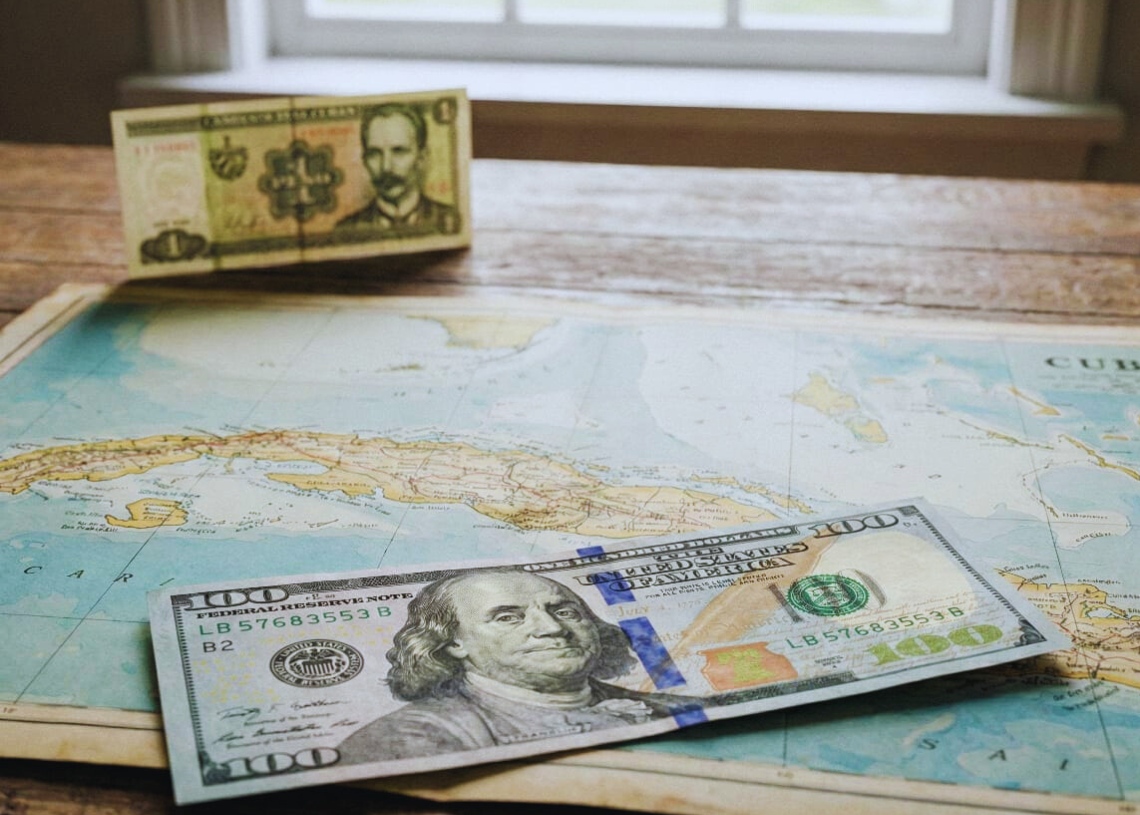
The publication of a regulatory package on dollarization has generated as much expectation as questions. First, the decree-law and the three resolutions that comprise it must be understood as the “rules of the game” for foreign currency transactions in the Cuban economy.
Second, internal foreign currency transactions are not new, nor is the policy of partial dollarization. This process began in 2019 with the first stores selling goods in freely convertible currency (MLC) for “medium and high-end” items. Since then, both state-owned and private enterprises have operated MLC accounts for foreign currency transactions. So, what’s new now?
The new measures expand the policy of partial dollarization.
In this sense, there are two “new” elements:
1) the appearance of real foreign currency accounts, which apparently replace MLC accounts, although this is not established in the regulations nor have the authorities confirmed it, and
2) these accounts (real foreign currency accounts) are adopted as the instrument for all foreign currency operations carried out by enterprises in Cuba.




This last point is important because state-owned and private enterprises have similar bank accounts for operating in Cuban pesos, but in foreign currency they have used accounts of a different nature until now.
While private enterprises operate MLC accounts, state-owned enterprises have what are called liquidity capacity (LC) accounts. LC is not a currency, but a “right” to purchase foreign currency.
For example, if the Ministry of Economy and Planning (MEP) allocated $10,000 to the LC account, the enterprise could acquire them from the bank. But since these are not real accounts, if more LC is allocated than the foreign currency actually circulating in the economy, convertibility is lost.
The MLC, which is also not a currency, seems to have followed the same path, losing convertibility, which means that the dollars appearing in account balances are not equivalent to real dollars. Now all enterprises will operate the same type of bank account: in foreign currency.
What is the guarantee that this problem will not happen again with foreign currency accounts? This must be answered by the Central Bank of Cuba (BCC).
The preceding paragraphs reflect the complexity of the country’s banking and financial system. Based on these elements, understanding the new measures and their impact requires analyzing their pillars: who can open and operate a foreign currency account, what their sources can be, what the retention coefficients are and what operations can be carried out.
Who can open a foreign currency account?
All economic actors are authorized to open foreign currency accounts. State-owned enterprises, private enterprises, cooperatives, self-employed workers, foreign investment businesses, among others, may request their opening from commercial banks.
One of the big questions about the new measures is what will happen to the MLC. Resolution 222/2021 of the BCC, which regulated the operation of these accounts, has been repealed by last week’s regulatory package. The truth is that the latest dollarization measures have been eliminating the usefulness of the MLC in the market: new state-owned stores that only accept Clásica Card or cash, purchases of fuel in dollars, and now the appearance of foreign currency accounts.
The sources of real accounts
Once opened, how are the real foreign currency accounts funded? The sources of foreign currency can be external or internal. External sources represent income from abroad for: exports, collections from e-commerce, as well as transfers, financing or donations received.
In contrast, internal sources mainly include sales within the national territory to: the Mariel Special Development Zone (ZEDM), entities authorized to trade wholesale and retail in foreign currency (for example, Tiendas Caribe), or a foreign investment business (for example, a joint venture). Other internal sources acknowledge: the purchase of foreign currency on the exchange market (yet to be implemented) and the allocations made centrally by the Ministry of Economy, which are mostly destined for state-owned entities.
And what is ACAD?
The Foreign Currency Access Capacity Allocation (ACAD) is another source of foreign currency, but it is not new. It can be considered a remnant of the aforementioned Liquidity Capacity (LC) accounts. It is a centralized allocation mechanism used by the Ministry of Economy to decide where to allocate money, generally from state entities that do not generate foreign currency. For example, since the Cuban Oil Union (CUPET) does not generate enough dollars to import all the fuel the economy demands, the MEP can allocate $70 million to buy a shipment of oil.
Therefore, although ACAD can apply to “any other individual or legal entity that is authorized,” as established in the respective resolution, its use is primarily intended for the state sector. It is not realistic to view ACAD as a source of foreign currency for the private sector.
The problem with this mechanism is that it distributes foreign currency generated by others. Therefore, it is crucial to maintain a correspondence between the foreign currency allocated via ACAD and the real foreign currency that backs it. Otherwise, the same situation of loss of convertibility of MLC, Cuban peso (CUC) and LC would occur.
How much do I retain and how much do I contribute?
However, not all foreign currency income is retained 100% in the accounts. A portion goes to the central state account. This proportion is called retention coefficient. For example, a coefficient of 80% means that for every $100 that enters an enterprise’s account, the enterprise keeps $80 and gives $20 to the State.
In practice, the coefficient is a state tax on foreign currency income. Although to some extent it is a disincentive for the enterprise that generates the dollars, it is an intermediate solution for the central state account to obtain foreign currency in the context of the chronic scarcity in the Cuban economy.
This is logical, considering that the central account is the one that finances the general needs of the economy and society, such as the purchase of fuel for power generation, the import of medicines or the financing of social projects that require foreign currency.
Retention and contribution coefficients are not new mechanisms in the Cuban economy. They essentially function for state-owned enterprises and are designed for each sector: the biotechnology industry has its own, the export of medical services another, the nickel industry another, and so on. Their objective is to decentralize export revenues among the involved actors to guarantee their replenishment. This frees them from having to request foreign currency allocations from the MEP, an administrative mechanism that hinders the agility of the value chain.
Business strategies
Although all economic actors can open a real foreign currency account and fund it with various sources, the payments and collections they can make are another matter. Operations that do not qualify under the new regulations are prohibited. For example, no micro, small or medium-sized enterprise (MSME) will be able to sell directly to the public in dollars, nor will any state-owned enterprise without the corresponding authorization.
Therefore, the business sector’s strategies for generating foreign currency can be structured for two scenarios:
- Generating foreign currency independently. This can be done through exports, which is not a simple activity. The merchandise must be competitive in price and quality to sell on the international market. On the other hand, Cuban regulations offer minimal incentives for exporting.
- Partnering with entities that generate foreign currency. The enterprise can obtain foreign currency according to the retention coefficients by selling to a joint venture, a business in the Mariel Special Development Zone, or a state-owned store that sells in dollars. This isn’t simple either, given that the demand in this sector is relatively small, so only the most competitive businesses will succeed.
Nothing new here: observant people will have noticed that for years, stores selling in MLC have been selling domestically produced goods such as ice cream, canned goods and vinegar, manufactured by MSMEs and other private businesses, as evidenced by the product labels. The sale of these products generates income in MLC for the MSMEs, demonstrating that this second strategy has been in use for years.
Pros and cons
The new measures on foreign exchange transactions deepen the dollarization of the Cuban economy, but they are not new at all. They maintain dollarization in business-to-business transactions. Positive points include:
- It maintains a decentralized system for the use of foreign currency. The State does not manage, control or allocate dollars through administrative and bureaucratic methods that hinder productive processes. Instead, a system is maintained where the entity that generates foreign currency can retain, invest and multiply it.
- It benefits exporters. Related to the previous point, the entire chain of production, industrialization and trade of exportable goods and services benefits from the possibility of using, recovering and generating foreign currency. The benefit extends to all enterprises with export potential, including the private sector.
- It puts state-owned and private enterprises on equal footing in the use of real accounts. In operational terms, the classification and functioning of bank accounts for foreign currency operations are standardized, establishing the same type of account for all economic actors. This can contribute to greater operational agility in partnerships between private and state-owned enterprises.
- It serves as a bridge to other measures. It is one of the measures that anticipate the implementation of the future official foreign exchange market, a key mechanism for buying and selling foreign currency.
However, the problems with these measures revolve around their approach, potential risks and the essential need for complementarity with other policies:
- Excessive segmentation. There is too much division between sources, actors and economic sectors, creating internal dollarized circuits in the Cuban economy that may become disconnected from those that operate only in pesos and do not have access to foreign currency. Furthermore, so many specifications can lead to misinterpretations of the regulations.
- It may anticipate risks in the supply chain of private trade. In Cuba, private businesses import all goods through state-owned import enterprises. Until now, due to distortions in the financial system, the authorities had allowed private businesses to pay their foreign suppliers from accounts in third countries. If one of the objectives of the new measures is to “regulate” this, the authorities could require private businesses to pay state-owned import enterprises from their foreign currency accounts in Cuba. These state enterprises would then pay the supplier to carry out the commercial transactions and import the containers of goods. This, while logical, would disrupt the way the supply chain has functioned until now, through which chicken, edible oil, milk, toiletries and all kinds of goods for retail trade enter the country. This is not a minor issue. If, on the other hand, none of this happens, the international operations of private businesses will continue outside the Cuban financial system, as they have until now.
- Increased demand for foreign currency and a rise in the exchange rate. The expansion of dollarization will increase the demand for foreign currency from businesses and households. An upward pressure on the informal exchange rate is foreseeable as long as this market continues to set the price of the dollar in the Cuban economy. This leads to another issue: the predictable establishment of an official exchange market, repeatedly announced in recent weeks.
- Possible discretionary power. Although initially no private business can sell in dollars to the population, MEP Resolution 140 introduces an exception for “authorized cases.” This is a policy error that is based, once again, on discretionary power. Under what criteria would a small group of micro, small and medium-sized enterprises (MSMEs) be allowed to sell in foreign currency?
- Economic and social inequalities. Deepening dollarization exacerbates the gap between those who have much and those who have little. Just as the business sector is segmented, society is segmented between those who have access to dollars and those who only have access to pesos. Consequently, it is a measure with social (and political) costs that must be managed with other strategies.
This set of regulations, in itself, will not generate an additional dollar tomorrow, nor will it increase the production of enterprises. In an oversimplification, we can confidently state that these laws merely regulate the use of the existing foreign currency, without necessarily stimulating its increase.
Dollarization must be considered within the broader framework of the country’s economic policy objectives. It can function as a springboard to revive the precipitous decline in a portion of production, but the country needs a productive transformation policy with pillars based on diversification, boosting sectors with higher added value and fostering innovation and knowledge. And this requires an investment pattern that does not prioritize hotel infrastructure at the most critical moment for Cuban tourism, for example. This issue is not addressed in the Government Program for correcting distortions and revitalizing the economy, which I recently analyzed.
Dollarization has been accepted as an “inevitable” step in the government’s plan to overcome the crisis, but it cannot be the final step. It must be acknowledged that predicting timelines is difficult in this matter. But the dollarization policy itself must define when and how to de-dollarize, in order to restore the Cuban peso to all its functions.







Why tie yourself to the dollar which is rapidly losing its status as the worlds reserve currency? Why tie yourself to the US which abuses you? Find another nation’s currency that is stable and and that nation is truly cooperative.