

ES / EN
- March 1, 2026 -
No Result
View All Result
OnCubaNews
  • World
  • Cuba
  • Cuba-USA
  • Opinion
    • Columns
    • Infographic
  • Culture
    • Billboard
  • Sports
  • Styles / Trends
  • Media
  • Special
  • Cuban Flavors
  • World
  • Cuba
  • Cuba-USA
  • Opinion
    • Columns
    • Infographic
  • Culture
    • Billboard
  • Sports
  • Styles / Trends
  • Media
  • Special
  • Cuban Flavors
OnCubaNews
ES / EN
Home Cuba

More Cuban “tourists” in Russia’s limbo

Every year more than 25,000 Cubans arrive in Russia, where they don’t need a visa for three months; but, of these, only about 25% register with the Russian immigration authorities, according to data from the United Statistical System of Russia (EMISS).

by
  • OnCuba Staff
    OnCuba Staff,
  • OnCuba editorial staff
May 19, 2020
in Cuba
0
In the photo, from left to right, Cubans Jesús Arrechea, Rafael Ajijunco, Yunieisi de la Caridad Izquierdo with her son Elier Arrechea Izquierdo, Pedro Luis García and Yuvani Marquetti Elías pose in a house in Moscow. Photo: EFE/Fernando Salcines.

In the photo, from left to right, Cubans Jesús Arrechea, Rafael Ajijunco, Yunieisi de la Caridad Izquierdo with her son Elier Arrechea Izquierdo, Pedro Luis García and Yuvani Marquetti Elías pose in a house in Moscow. Photo: EFE/Fernando Salcines.

More than a hundred Cubans who’re in the business of reselling merchandise, known on the island as “mules,” are still stranded in Moscow, a city they barely know and where a language they don’t master is spoken. The coronavirus pandemic has left them trapped: the city closed its land and air borders, and has imposed confinements to stop COVID-19, which prevents them from working to survive or returning home.

“People who travel to Russia to buy merchandise for Cuba usually come for seven days, because a long stay does not give them a profit,” explains Pedro Luis García, a Cuban who has lived in Moscow for eight years and supports his fellow citizens with legal advice and food aid.

Now, many have been locked up for almost two months, with no money to eat or pay the rent. They also have no return date in sight. García indicates that more than 20 people can live in just one apartment in rooms with three or four bunkbeds and with the corridors full of bales with merchandise.

But, those who return are not the only Cubans who find themselves in a difficult situation in Russia due to the restrictions imposed to contain the coronavirus. Those who arrived with the intention of staying and starting from scratch also have a hard time.
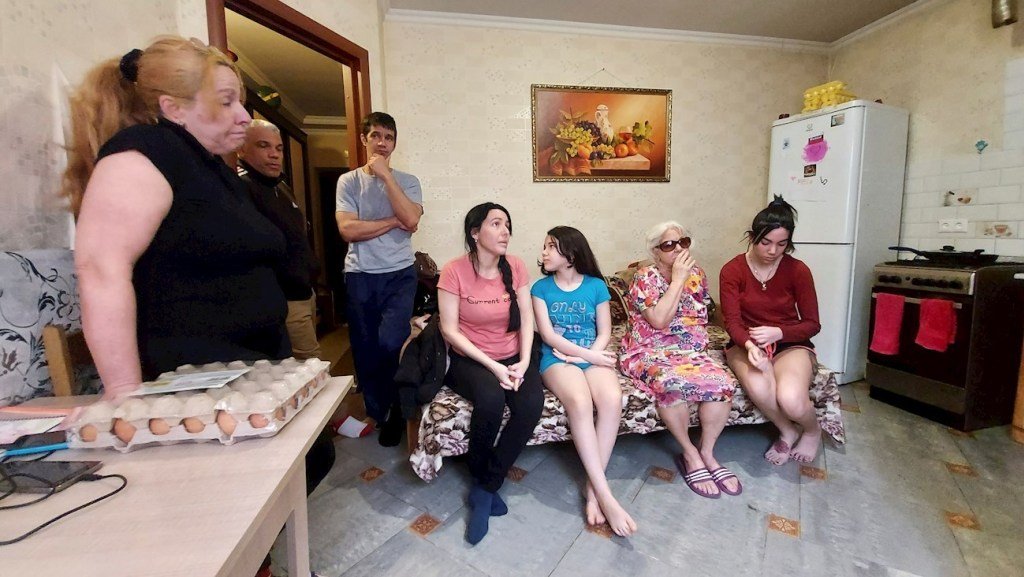
In the photo, from left to right, Cubans Idalmis Moreno, Juan José Valdés, Leinier Valido, Yuneisi Companioni, Melodi Valdés Companioni, Martha Batista Pérez, Natalia Valdés and Thalía Valdés pose in a house in Moscow. Photo: EFE/Fernando Salcines.

“It is not easy,” Yadira Mendoza, a native of Santa Clara, confesses sadly.

The COVID-19 has confined her to the apartment of a modular building in a dormitory neighborhood in southern Moscow, where she shares a roof with her husband, brother and three other people.

Related Posts

Transport in Cuba. public transportation in Havana.

The island, the icebergs

February 23, 2026
Cuba. A woman attempts to board an electric tricycle.

When Fuel Runs Out, Life Comes to a Halt

February 18, 2026
Cuban Economy.

The imperative of economic reform in Cuba

February 5, 2026
Germán Mesa. World Baseball Classic

Germán Mesa and his players optimistic ahead of upcoming World Baseball Classic

January 31, 2026

They live crowded in two rooms in poor condition and with the minimum necessary to live. And they are in an irregular situation.

Yadira does not give up and hopes that everything will improve, because she is in Russia “for the family” and does not plan to return to Cuba, where she sold her house to conquer new horizons.

Pedro Luis García explains that many arrive in the country without having previously been informed of the laws and without knowing the language, which makes them vulnerable to abuse and scams.

Remember that several of them were told in Cuba that Russia belongs to the Schengen area, so they could use that country as a springboard to reach the Old Continent. They didn’t get information before burning their bridges at home.

“If you give a Cuban work, he’ll does whatever he has to do, but we have to be paid,” says Yuvani Marquetti Elías, a native of Alquizar, in a house on the outskirts of Moscow.

DECEIVED

Yuvani belongs to the group of Cubans who feel they were deceived. “We came with the idea of ​​getting ahead, of working,” he says.

He affirms, without being able to contain his anger, that he has been paid 3,000 rubles (less than 50 dollars) for two months of work in a store, taking advantage of his undocumented immigrant status.
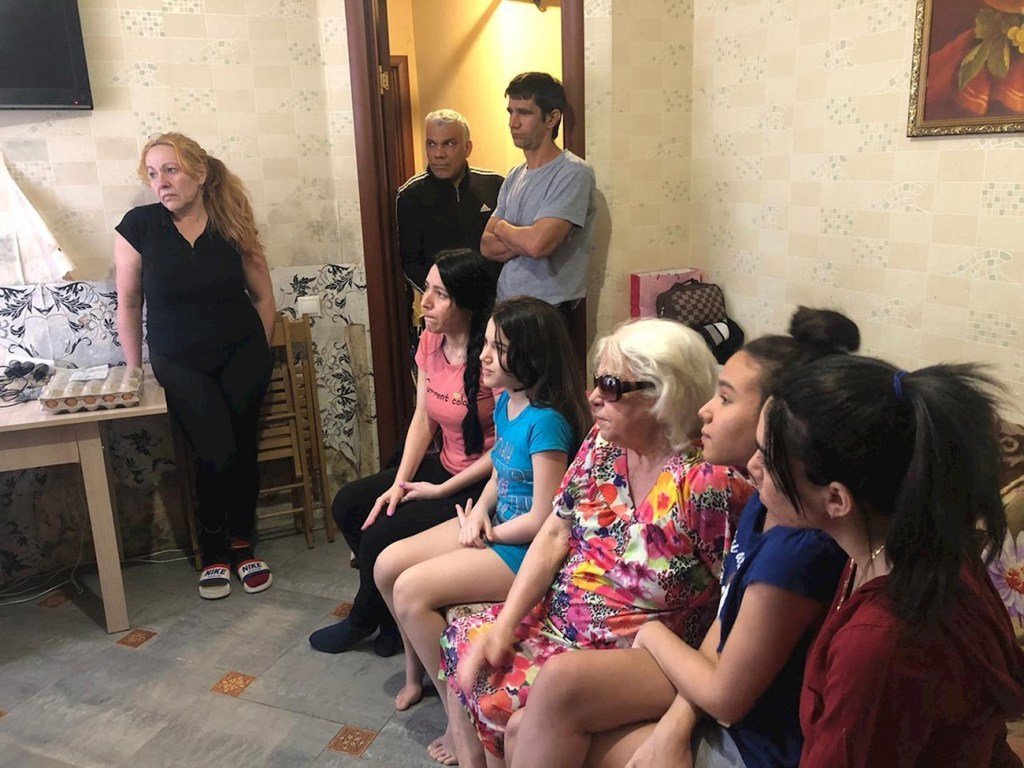
In the photo, from left to right, Cubans Idalmis Moreno, Juan José Valdés, Leinier Valido, Yuneisi Companioni, Melodi Valdés Companioni, Martha Batista Pérez, Natalia Valdés and Thalía Valdés pose in a house in Moscow. Photo: EFE/Fernando Salcines.

He lives with his family in a half-built house: the concrete blocks on the wall are bare, which does not prevent the owner from asking for a monthly payment of 36,000 rubles (about 500 dollars), a sum they don’t have.

He has even had to ask relatives in Cuba for support to pay the rent, while for food he depends on the help provided by volunteers like Pedro Luis.

This law graduate who teaches Spanish in Russia can’t offer much.

He can barely give needy Cubans two bags full of macaroni, flour, oil, spices, onions, eggs and a chicken. He also brings them toiletries.

He affirms that some Cubans he visits live in “terrible conditions” and remembers an aid package delivery at a house without heating, without water and with a bathroom outside where 39 compatriots lived, including a small child.

“In the time I’ve been doing this, around 500 people have contacted me,” he says.

Almost all those who embark on the Russian adventure do so without notions of the necessary procedures to legalize their immigration status, and even for those with some knowledge the process is arduous.

LEGALIZATION IS HELL

“It’s like a labyrinth with no way out,” Idalmis Moreno, trapped for two years in a swamp of bureaucracy, sums up her desperation.

It was useless to start the procedures according to Russian law: she’s still waiting for the authorities’ response. And if she still has vestiges of patience, the money ran out long ago.

https://oncubanews.com/cuba/moscu-no-cree-en-lagrimas-cubanos-varados-en-rusia/

She shares a threadbare sofa bed with her husband and her 78-year-old mother, who has a string of diseases, in an apartment on the outskirts of Moscow with her daughter, son-in-law and three granddaughters who have not attended school for two years.

“It hurts to see these people in these conditions, two years trying to legalize their situation,” says Pedro Luis.

Idalmis’s daughter has tried to return to Cuba with her three daughters, but the renewal of the four passports costs 32,000 rubles (about 438 dollars), a prohibitive sum for her.

Even if she managed to raise the money, the absence of international flights would not allow her to return now to the island, as is the case with other Cubans stranded in the Russian capital.

The Cuban Consul in Moscow, Eduardo Lázaro Escandell Santana, assured EFE that the Embassy and the Consulate maintain “permanent communication” with all Cubans who have contacted the diplomatic mission and they have been oriented on how to extend their stay or regularize their immigration status.

He also emphasizes that they have been offered options “to meet the needs of those with financial and housing difficulties.”

Since Cuba repealed the so-called “exit permit” in 2013, Russia has become one of the non-Spanish-speaking destinations that thousands of Cubans turn to in search of a better future.

EFE/OnCuba

  • OnCuba Staff
    OnCuba Staff,
  • OnCuba editorial staff
Tags: coronavirusCuba and Russiacuban immigrants
Previous Post

Coronavirus in Cuba continues declining: no deaths and 6 infections reported today

Next Post

How will the recovery of tourism in Cuba take place?

OnCuba Staff

OnCuba Staff

OnCuba Staff

OnCuba Staff

Next Post
Photo: Ismael Francisco/AP.

How will the recovery of tourism in Cuba take place?

Havana and Matanzas, the provinces that reported new infections until midnight yesterday. Photo: Otmaro Rodríguez.

A week without deaths in Cuba from COVID-19

Damage caused by a severe local storm in Ciego de Ávila, in central Cuba. Photo: Invasor/Facebook.

Strong storms cause damage to homes and others in Cuban towns

Leave a Reply Cancel reply

The conversation here is moderated according to OnCuba News discussion guidelines. Please read the Comment Policy before joining the discussion.

Your email address will not be published. Required fields are marked *

Most Read

  • The Enchanted Shrimp of the Cuban Dance

    5490 shares
    Share 2196 Tweet 1373
  • Trump suspends tariffs on oil suppliers to Cuba: will the energy blockade remain in place?

    32 shares
    Share 13 Tweet 8
  • The island, the icebergs

    10 shares
    Share 4 Tweet 3
  • U.S. actress Susan Sarandon praises Cuban vaccines and calls for end of embargo against the island

    154 shares
    Share 62 Tweet 39
  • Her name is Bersil Iglesias, she’s Cuban and she danced alongside Bad Bunny at the Super Bowl

    8 shares
    Share 3 Tweet 2

Most Commented

  • María Paula Otero. Photo: Courtesy.

    Between paper and embroidery, María Paula focuses on sustainable beauty

    21 shares
    Share 8 Tweet 5
  • A bridge of keys between Manhattan and Havana

    6 shares
    Share 2 Tweet 2
  • U.S. says it will allow Mexico to continue supplying oil to Cuba

    40 shares
    Share 16 Tweet 10
  • About us
  • Work with OnCuba
  • Terms of use
  • Privacy Policy
  • Moderation policy for comments
  • Contact us
  • Advertisement offers

OnCuba and the OnCuba logo are registered® trademarks of Fuego Enterprises, Inc., its subsidiaries or divisions.
OnCuba © by Fuego Enterprises, Inc. All Rights Reserved.

No Result
View All Result
  • World
  • Cuba
  • Cuba-USA
  • Opinion
    • Columns
    • Infographic
  • Culture
    • Billboard
  • Sports
  • Styles / Trends
  • Media
  • Special
  • Cuban Flavors

OnCuba and the OnCuba logo are registered® trademarks of Fuego Enterprises, Inc., its subsidiaries or divisions.
OnCuba © by Fuego Enterprises, Inc. All Rights Reserved.

Manage Consent
To provide the best experiences, we use technologies like cookies to store and/or access device information. Consenting to these technologies will allow us to process data such as browsing behavior or unique IDs on this site. Not consenting or withdrawing consent, may adversely affect certain features and functions.
Functional Always active
The technical storage or access is strictly necessary for the legitimate purpose of enabling the use of a specific service explicitly requested by the subscriber or user, or for the sole purpose of carrying out the transmission of a communication over an electronic communications network.
Preferences
The technical storage or access is necessary for the legitimate purpose of storing preferences that are not requested by the subscriber or user.
Statistics
The technical storage or access that is used exclusively for statistical purposes. The technical storage or access that is used exclusively for anonymous statistical purposes. Without a subpoena, voluntary compliance on the part of your Internet Service Provider, or additional records from a third party, information stored or retrieved for this purpose alone cannot usually be used to identify you.
Marketing
The technical storage or access is required to create user profiles to send advertising, or to track the user on a website or across several websites for similar marketing purposes.
  • Manage options
  • Manage services
  • Manage {vendor_count} vendors
  • Read more about these purposes
View preferences
  • {title}
  • {title}
  • {title}