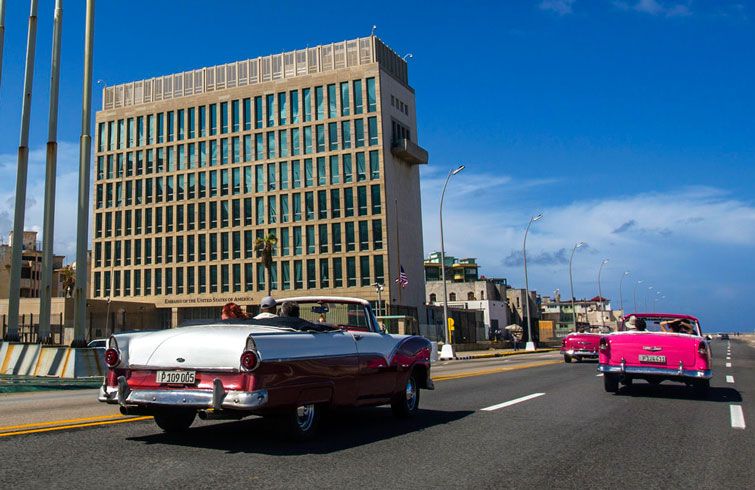

New evidence related to the alleged incidents that affected U.S. diplomats and their families in Havana point to dismantling the hypothesis of the “acoustic attacks,” managed until now by the media and government sources from that country as the cause of the effects.
Strong and mysterious sounds, followed by buzzing and loss of hearing led investigators to be suspicious of this type of “attack.” Now the U.S. authorities are avoiding the use of that term. They affirm that it is not clear that the sound could be responsible.
The sounds could be a secondary effect of something else that caused the damage, pointed out three federal officials cited by the AP news agency and who had information about the investigation and asked for anonymity because they were not authorized to publicly speak about the topic.
Their statements were made after the doctors who are seeing those affected discovered that they also presented neurological disorders.
The tests made revealed that the diplomats developed changes in the sections of white matter that allow for communication between several parts of the brain, said the U.S. officials cited by AP, who affirmed there is a growing consensus among university and government physicians who are investigating the attacks.
The white matter acts as a link between the neurons.
Until now this is the most specific finding of physical damage, which shows that what hurt the victims caused changes perceptible in their brains. The discovery accentuates the growing skepticism about the possible used of a sonic weapon in the incidents denounced by the government of Donald Trump.
The “sonic” puzzle
Physicians, FBI and U.S. intelligence agency investigators have spent months trying to discover what happened in Havana, where Washington affirms that last year 24 persons fell ill, including officials and their spouses, in their homes and subsequently in some hotels.
Some Canadian diplomats were also affected.
The affected Americans reported sounds that could only be heard in certain parts of a room, but not a few steps away, compared to a normal sound that is dispersed in all directions.
Secretary of State Rex Tillerson said that he is convinced that these sounds were directed attacks, but that his government doesn’t know who is behind them.
The physicians say they don’t know why the victims ended up with changes in the white matter or how these changes could be related to their symptoms. The federal authorities did not say if the disorders were registered in the 24 patients.
Elisa Konofagou, professor of biomedical engineering of the University of Columbia, who is not participating in the government investigation, said it has never been demonstrated that acoustic wavelengths are capable of altering the sections of white matter in the brain.
Konofagou said she would be greatly surprised and added that modern medicine frequently uses ultrasounds in the brain and they have never seen problems in the sections of white matter because of that use.
Previous studies have found concussions and damages in the white matter in soldiers who survived explosions in the Iraq and Afghanistan wars, without presenting other physical damages. But those lesions were attributed mainly to the shock wavelengths of the explosions. None of the patients from Havana reported explosions or blows to the head.
Foreign medical experts point out that when there is such a small sample of patients it is complicated to establish a cause and effect.
Dr. Gerard Gianoli, a Louisiana neurological specialist, said that what they have to ask each time something is seen in a scan is if it due to an episode of stimulus or if it was something that preexisted and had no relation to what happened.
Recoveries, uncertainties, certainties
The case of the alleged attacks has placed the U.S. medical community in an unknown territory. The doctors are treating the symptoms as if it was an ailment never seen before.
Most of the patients have completely recovered, some after rehabilitation and others through treatments, the officials affirm. Many already returned to their jobs. Around 25 percent of the victims presented symptoms during long periods or persist to date.
After exhaustive tests and experimental therapies they are developing the first protocols to examine the cases and identify the best treatments, even while the FBI investigation is having a hard time identifying what is responsible, a method or a motive.
According to the officials, new incidents have not been reported since late August and it is planned for the affected diplomats to be monitored for life in the face of possible long-term consequences.
Cuba has denied responsibility in the “incidents” and has questioned the veracity of the affirmations of the Trump government, based on its own investigation that has found no evidence of alleged attacks.
It has also denounced the lack of U.S. collaboration in the study and the non-presentation of convincing proof by Washington, something which could change if the new revelations were confirmed.
After an increase in diplomatic tension with the island, the Trump administration ordered in September the withdrawal of the major part of its officials in Havana and expelled Cuban diplomats from the United States.
Ben Rhodes, former President Obama’s adviser and right-hand man and one of the architects of the U.S. change of policy toward Cuba during Obama’s time in the White House, has affirmed that the Cuban government has not been responsible for the “acoustic attacks.”
In an interview given at the same time to El País, Le Monde and Der Spiegel, Rhodes affirmed that the Cuban government was not responsible, that while the attacks were taking place Havana had signed all type of agreements with the U.S. and was trying to improve relations, adding that Cuba had reacted with great moderation.
It is expected that the U.S. physicians who are treating the victims will present their findings in an article of the Journal of the American Medical Association.
According to the officials, the article will not speculate on the type of technology that could have caused the damages or about who would want to affect the Americans in Cuba. Its authors are MDs from the University of Miami and the University of Pennsylvania, with contributions by the medical unit of the Department of State and other government physicians.
AP / OnCuba