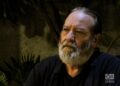
At 6:00 pm of a Monday I was waiting at the door of the building for Omar Puente for our interview, when I saw him walking with the five-string violin hanging from a shoulder and a bottle of soda in the other hand. He honestly does not appear to be a successful musician, someone who is residing in England since 1995. The apartment, with an enviable balcony facing the Presidents Avenue, does not seem either to belong to someone who has shared the stage with John Williams, Robert Mitchell, Whitney Houston, Donna Summer and Kirsty MacColl, among others.
***
The day he went alone to study in Havana, the terrified family could not foresee that violin would travel around the world in the hands of Omar. None of his classmates who saw him in the scholarship seated any Sunday watching TV, salivating with Nitza Villapol´s programs, and imagining the smells of home food, or peeling telephone cables for getting an E string, or tying Cassette tapes with acetone to hear Brazilian music, John Coltrane and Miles Davis, could have imagined that at all. “That independence helps you to become stronger, to overcome obstacles,” he says. By then, after finishing his studies at the Esteban Salas Conservatory in Santiago de Cuba, Omar had already graduated from the National School of Art (ENA by its Spanish acronym) and continued his studies at the higher level, at the Higher Institute of the Arts (ISA by its Spanish acronym).
“I had very good teachers such as Evelio Tieles, who has been the creator of the Cuban violin school, as Leo Brouwer did with the guitar. I was also taught by Russian teachers, because there was a very strong relationship with that country at that time. And they were excellent teachers. That educational period up to 16 years, without interruption, is a stronghold and a very solid base for me. “
***
I came late to the conference of the Institute of Music, because you can not have your cake and eat it. And who is that? I asked unanswered. Omar Puente, enjoying the sun in Havana by these days, spoke about the reopening and restoration of the Miramar Theatre, in Playa municipality. He said he was very pleased with the results of that revival project, driven by the Cuba Solidarity Campaign in Britain, with which he is directly linked.
“It was at the Miramar Theatre where I had my first experiences with the public. That theater was widely used by youth artists for their training and initiation. Many great Cuban artists, including Patricio Wood and Osvaldo Doimeadiós performed there “he said.
Then there was social chronicle, because there are equivalents of Romerillo or Los Pocitos neighborhoods everywhere in the world. “When a project emerged in Venezuela called El Sistema, it was born the famous Simon Bolivar Symphony Orchestra. With them we had the initiative by trying to reach urban areas, communities of lower income, or marginalized. We wanted to give the children of those places the opportunity to become useful people to mankind , and we used music as a tool for that. That same principle is now being applied in England, all around the country. The project is called In Harmony Opera North, and I’m working in that too. “
***
The National Symphony Orchestra demanded to read fast. It is a school of skills for those who are just graduated from ISA. I learned a new repertoire each week, without truce or time. Omar saw that the oldest member of the orchestra always read a note ahead of the one they were playing, they learned the closing stages of a page and continued playing the next, or they just needed to watch for a few seconds any rhythmic pattern and they could play it. They had to learn to play together, to value silence as part of the same music.
Every day, in the 15 or 20 minute break, Omar learned to play the contrabass from a friend. He remembered a lot that period in the National Symphony when, in the early months of his arrival in England, the first job he had was playing bass in an orchestra. Then came jazz, if not because it was always there.
Omar Puente
The Best Foot Foward is the second part of an organized division of creative stages that Omar Puente has done of his own work. “The first album, ¨From there to here¨, contains everything I learned from the Chinese trumpet, Celtic music, church music, children’s choirs and African music, especially following my concert by those lands. This part is already on Omar Puente in Brazil, Asia, the Caribbean, in Senegal ; it is about a new way of writing and playing, a new vision of my career, “he told.
***
Gustavo Tamayo played the guiro in Rubalcaba´s Typical Charanga. There was also the renowned Cuban bassist Cachao and Joaquin Olivera (El jilguero) with a wooden flute. Omar Puente began playing danzon as if the songs were works of Brahms, and it was the man of the guiro who , without any musical technical expertise, taught him the correct technique. Then, with Enrique Jorrín Orchestra (with Mr. Ruben Gonzalez), he learned the cha-cha. As a result of that training, we can say today that when Puente plays Brahms, he denotes influence of Danzon, Rumba and Guaracha.
***
For years he has been teaching in Cuba every time he comes, as often as possible . He even donated his book ¨Play violin in the C uban way¨ , which is a compilation of his experience in the groups that formed him. It is not a history book, but of methodology, which makes it even more unique that the very fact of being a book on violin.
“According to what I know , and I can be wrong, there has been no Cuban violinist who has written something like that for violin. For every book on violin, there are 50 of percussion, 100 of bass and 200 of piano. My interest, and the function of the text, is to put the violin in the place that I think it deserves. The violin is represented in all cultures, it is present in the country , in gypsy music, Russian music, in charanga, but in jazz it has not given the prominence it really has. The Cuban school of violin is internationally recognized in the classical field , but we have no tradition of jazz. And we must also strengthen it, “the musician noted.
***
In 1979 there was a concert at the Karl Marx Theater that became Omar Puente a lover of Latin Jazz. It was one of the first cultural exchanges between Cuba and the United States after January 1959. There were Ruben Blades, the Charanga of 73 and , among other guests, the Weather Report Orchestra. Among the members of that band we are interested in the then young Peter Ski, on drums, and Wayne Shorter, one of the masters of jazz worldwide.
“That concert changed my life. I wanted to make that music, though I was not even remotely prepared to make it. I wanted the audience who would listen to me to feel the way I felt that night. “
Approximately 20 years later, Peter Ski showed the Cuban violinist black and white photos of that night that he kept. And he confessed that, at that concert, he was not ready for that music.
***
The violin-man has not only recorded with Frank Fernandez (at the beginning of his career), Frank Fernández, Leo Brouwer, Silvio Rodríguez and Pablo Milanés. He has also composed music for TV series, ballet, he has made arrangements for Havana’s Quartet group, worked with Venezuelan Symphonic Orchestra, has competed in dozens of festivals, and he was involved in Denis Baptistes´ national tour: ¨Let Freedom Ring¨ to commemorate the 40th anniversary of ¨I have a dream¨, the legendary speech of Dr. Martin Luther King… etc.
A few days ago, a friend recalled him the song he recorded with Vitier and he hummed the melody. Omar Puente felt happy.