
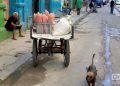


The low food productivity is one of the most critical problems that the current government of President Raul Castro inherits. Three years after the first rescue measures, the Cuban countryside remains paralyzed without much hope.
In a Caribbean archipelago without much industrial fuss, agriculture should work towards self-sufficiency. But, paradoxically, a country of 11 million 167 thousand inhabitants, imports 80 percent of what is consumed.
So what comes to the table if the everyday Cuban ? Under what conditions our food industry survives?
By 2013, the Minister of Economy and Planning , Adel Yzquierdo , announced to Parliament an estimate of expenditure of nearly two billion dollars in the purchase of food , figure ” significantly higher than the previous year ” , in which they planned a purchase of about 1.7 billion dollars.
For his part, Ag Minister, Gustavo Rodriguez Rollero notified the country’s top legislature of an increase of two percent in 2012, reporting that, according to the National Bureau of Statistics and Information, includes heavy casualties in the cultivation of potatoes and cassava, a rotten tomato harvest resulted in plans of vegetables to be lower than expected, and deficiencies in the crops of rice, corn, beans, tobacco, and in the production of milk, coffee, citrus, eggs and animal feed. Which are the causes alleged in Parliament: natural disasters, lack of foresight and job training, phytosanitary problems, faulty infrastructure, soil sampling and water supply…
However, the low productivity of the Cuban countryside seems not a circumstantial matter.
Dr. Santiago Rodríguez Castellón, from the Center for the Study of the Cuban Economy, lists some problems that persist in the countryside, including 40 percent wastage of arable lands. “Out of the land under exploitation an important slice is devoted to export production,” he says.
To this is added the high rates of degradation by indiscipline or technical unknowns (the non- crop rotation or chemical abuse), and the lack of adequate supplies amid economic hardship in the country.
The soil also suffers the wear of centuries of exploitation. Experts from the Institute of Soil argue that the continued use of tractors with obsolete implements for plowing and decompress exacerbate weed and lead to erosion. At the same time warning of the low productivity of the land, and refute the false belief of red soil fertility. “In Cuba, 70 percent of the land is included in the category of very little productive.”
But the reality surpasses all statistical and imposes, in turn, a sociological look at the Cuban countryside.
Heat about noon shows groove desolation. Agricultural activity earlier reported a deficit estimated between 100 and 150 thousand workers; unflattering situation at this point, with a younger generation that prefers mostly to opt for the opportunities of urban life.
The humanist philosophy for over 50 years has primacy in our process led to the assumption of a policy of universal education under the slogan “A Revolution is the daughter of culture and ideas.” With the lofty goal of making a village Cuban scholar, massive character university initiatives were promoted, committed to a comprehensive culture for all, disregarded existing demographic differences as well as the professional needs of developing economies.
The result is a migration process from the countryside into the classroom, and a loss of vocation trades, technical or profile agribusiness studies, which together with the dismantling of many sugar mills contributed to human moves of epic proportions towards urban environments.
According to researchers of the Institute of Physical Planning, in the past quarter century about one million Cubans have emigrated from small communities and rural settlements to the municipal and provincial settlements. In fact, 85 percent of the population is urban and by transitivity, food production falls on the shoulders of a meager 15 percent, a figure even more alarming if longevity statistics are reviewed, because Cuba has the oldest population of the continent.
For now, the low productivity keeps awake many of the experts and policy makers.
Dr. Omar Everleny Perez, for the Center for the Study of the Cuban Economy, said that this decline is a matter of inputs and outputs: “The input area implies that the farmer can buy his fertilizers, his fuel, and his farm machinery. Why a Cuban can buy a truck and cannot buy a tractor? In the output area is the subject of trades, the problem of packaging needed by the farmers to sell their produce. “In short, not enough national food arrives at the table of the Cuban.
And here we paraphrase the German philosopher Feuerbach, which has proven its effectiveness over a century: “Man is what he eats.” Then, we need to eat, and eat well!
The persistence of idle land and majority use of active land for export, the mismanagement of farming techniques, lack of supplies and equipment, and the persistence of bureaucratic failures (mostly failures in hiring and in the collection) attached to natural wear of the soil, together in a field hungry for youth, or at least a few productive and efficient hands.
Given this situation as daunting, Cuban decision makers have designed the Guidelines called heralds for improving socio-economic and political management in the Island
In this initiative, agriculture requires asterisks, quotes and even brackets. But what is the true depth of these changes?
You can read it tomorrow in the second part of this article.
By: Malvy Souto Lopez
Internet photo