Ask Cuban Americans whether Washington should squeeze Havana harder and most say yes. The 2026 FIU Cuba Poll, which surveyed 1,004 of them, asked the question four ways, and each way produced a majority. Sixty-one percent favor continuing the sixty-four-year-old economic embargo. Sixty-five percent support the oil blockade. Seventy-three percent favor U.S. military action against the Cuban government. Seventy-seven percent want Washington to emphasize maximum pressure, and 63 percent say so strongly (Grenier and Lai 2026).
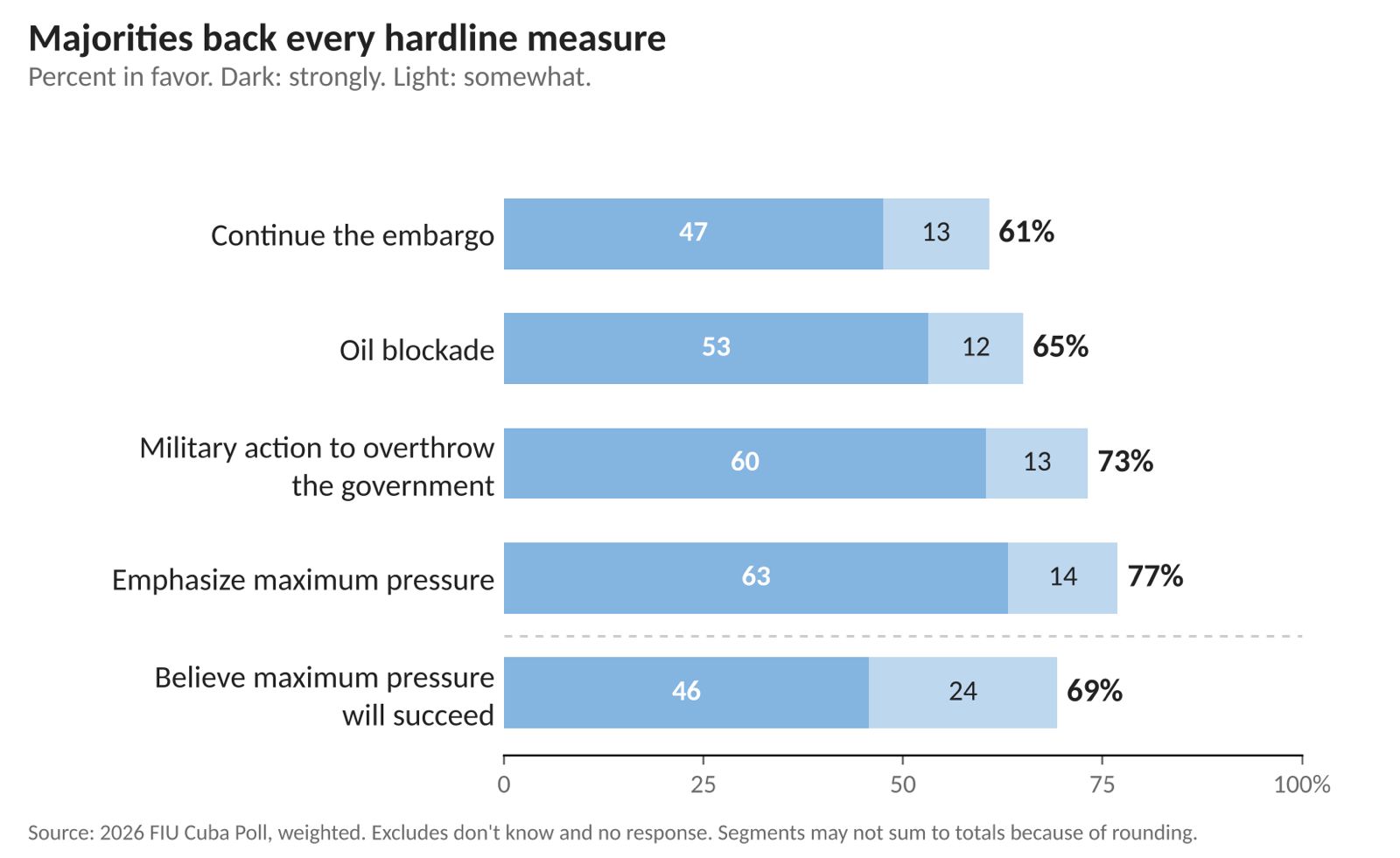
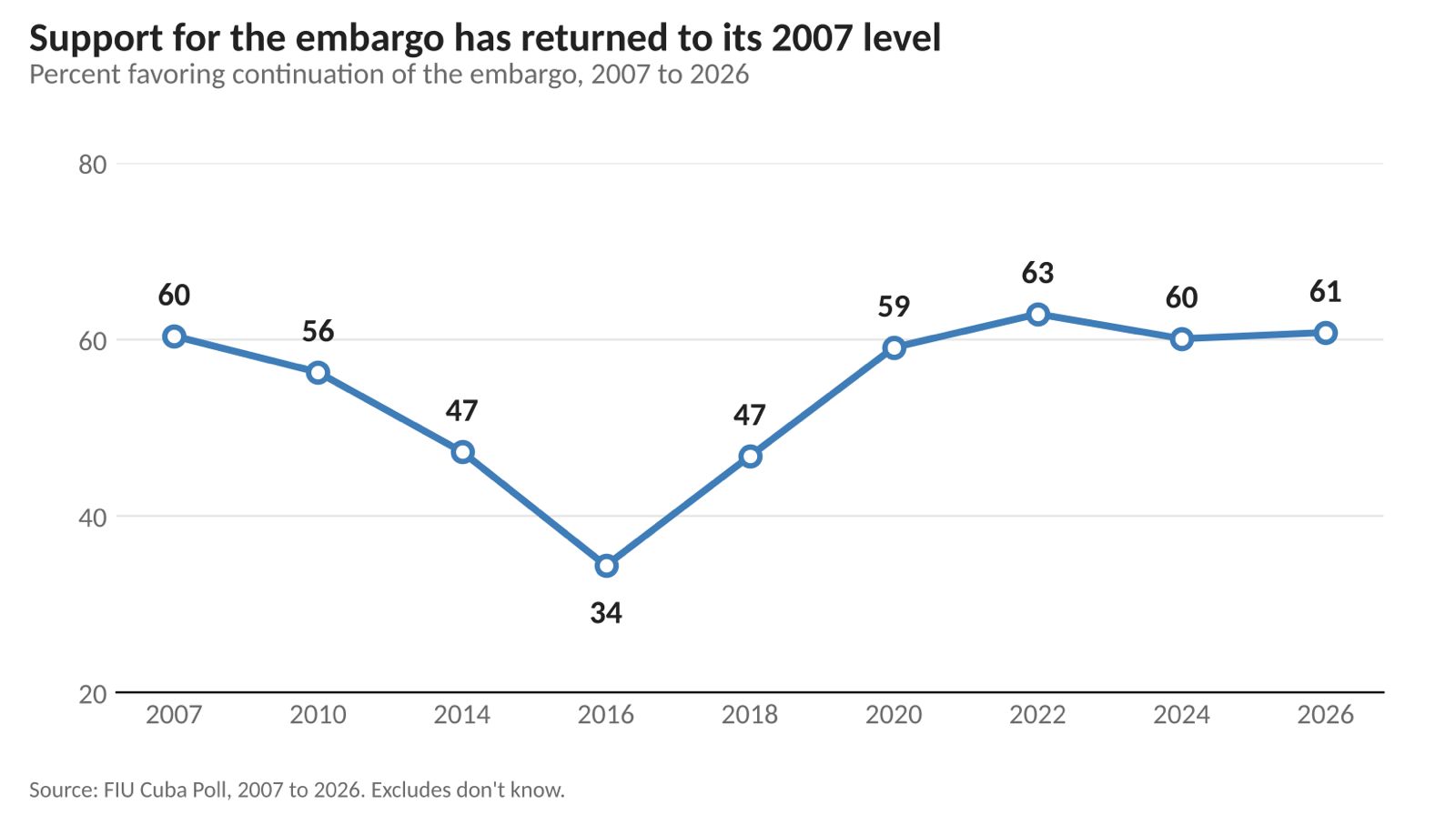
Read those numbers as a ladder of pain, with support climbing as the rungs get steeper. The embargo is the bottom rung and the oldest. Support for it stood at 60 percent in 2007, fell to a low of 34 percent during the Obama years, and has climbed back to today’s 61. The embargo has gone more than sixty years without changing the government, and the community’s support never really depended on results. It is the longest-lasting vestige of the alliance between the exiles of the 1959 Revolution and the State of their new country. It justifies the label of exile, however much the world has changed since that Cold War handshake between two allies vying to overthrow the Cuban government. The blockade is the newest rung, aimed at choking the island’s fuel supply and, with it, the energy of the Cuban people, who have to deal with the hardships it imposes. Maximum pressure names the whole strategy. Military action sits on the top rung, though the top is thinner than 73 percent suggests. Asked what kind of intervention they prefer, 43 percent chose clandestine action, 28 percent chose strikes on selected military targets, 15 percent chose all of them, including the bombing of urban areas, and 14 percent chose a land invasion.
The strategy rests on a very unclear theory of how “maximum pressure” will bring about change. In January President Trump, never one to bombard us with details, said Cuba was “just going to fall” (Nicas 2026). More recently, Secretary of State Marco Rubio said he wants Havana to learn there are “no escape valves” (Ferguson 2026). Cuban Americans mostly accept the vagueness as scripture. Sixty-nine percent believe maximum pressure will succeed, and 46 percent believe it strongly.
Still, the government has not fallen. Jack Nicas of the New York Times spent a week on the island this summer and reported that Cuba, cut off from fuel, is still surviving (Nicas 2026). The pressure is having a devastating impact on the people, though. Doctors told the Times that patients are dying because of the blockade (Augustin and Nicas 2026). The Cuban government no doubt shares the blame for some of this hardship. Its archaic and ineffective economic policies have few defenders among economists on the island or abroad. It is frantically trying to rearrange the deck chairs by giving the private sector more rein in the economy, hoping that it is not too little too late. Still, no unilateral move that the government can make will improve the wellbeing of the Cuban people significantly unless the United States releases its chokehold and engages in negotiations with the focus of alleviating the suffering, not simply destroying the government.
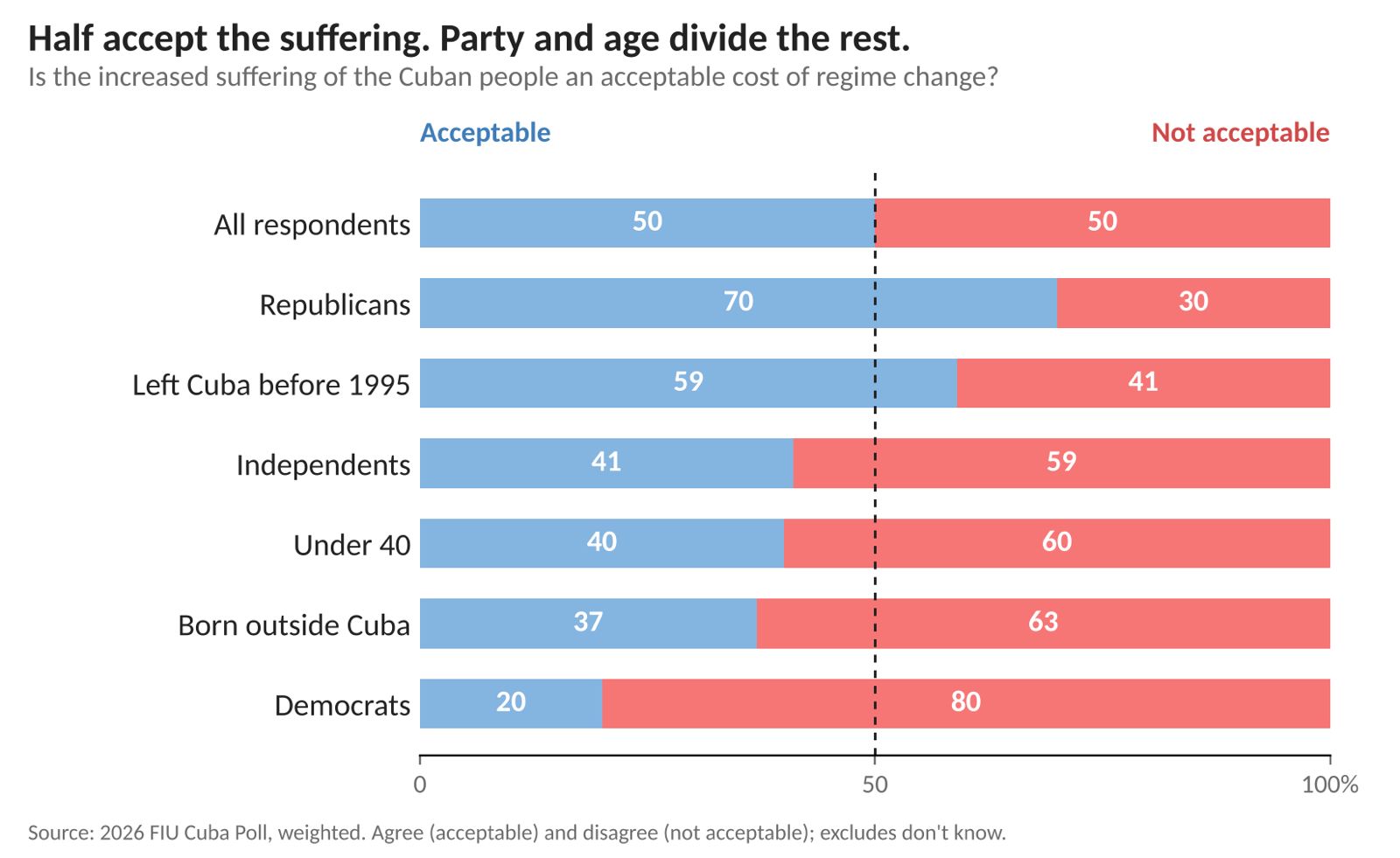
We asked Cuban Americans to consider the cost being paid by the Cuban people in this vortex of diplomatic inertia: is the increased suffering of the Cuban people imposed by U.S. policies an acceptable cost to achieve regime change? Half agree and half disagree, and 37 percent disagree strongly. The split follows familiar lines. Seventy percent of Republicans accept the cost, and 20 percent of Democrats do. Among Independents, 59 percent reject it. So do 60 percent of respondents under 40 and 63 percent of those born outside Cuba. Respondents who left the island before 1995 accept it at 59 percent.
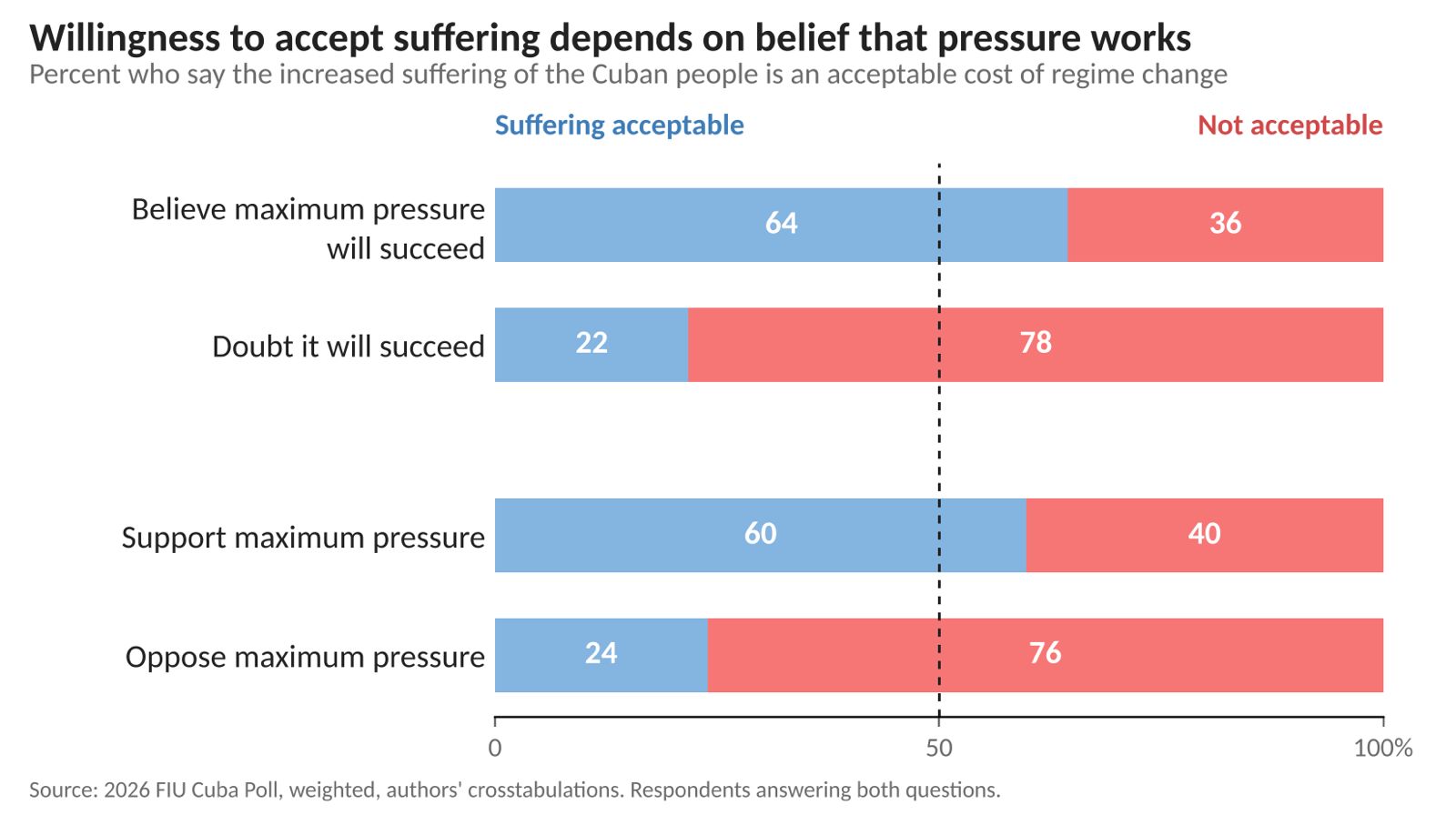
 What props up the acceptance? Belief that the strategy will work. A bit of analysis shows us that among respondents who think maximum pressure will succeed, 64 percent accept the cost. Among those who doubt it, 22 percent do. Among those who support maximum pressure, 60 percent accept the cost; among those who oppose it, 24 percent do. If the strategy keeps producing hardship and no political change, the poll suggests that the willingness to sacrifice the well-being of the Cuban people will not hold. But how long before the cost becomes unacceptable? The embargo has made it over sixty years, most of them with strong support from Cuban Americans.
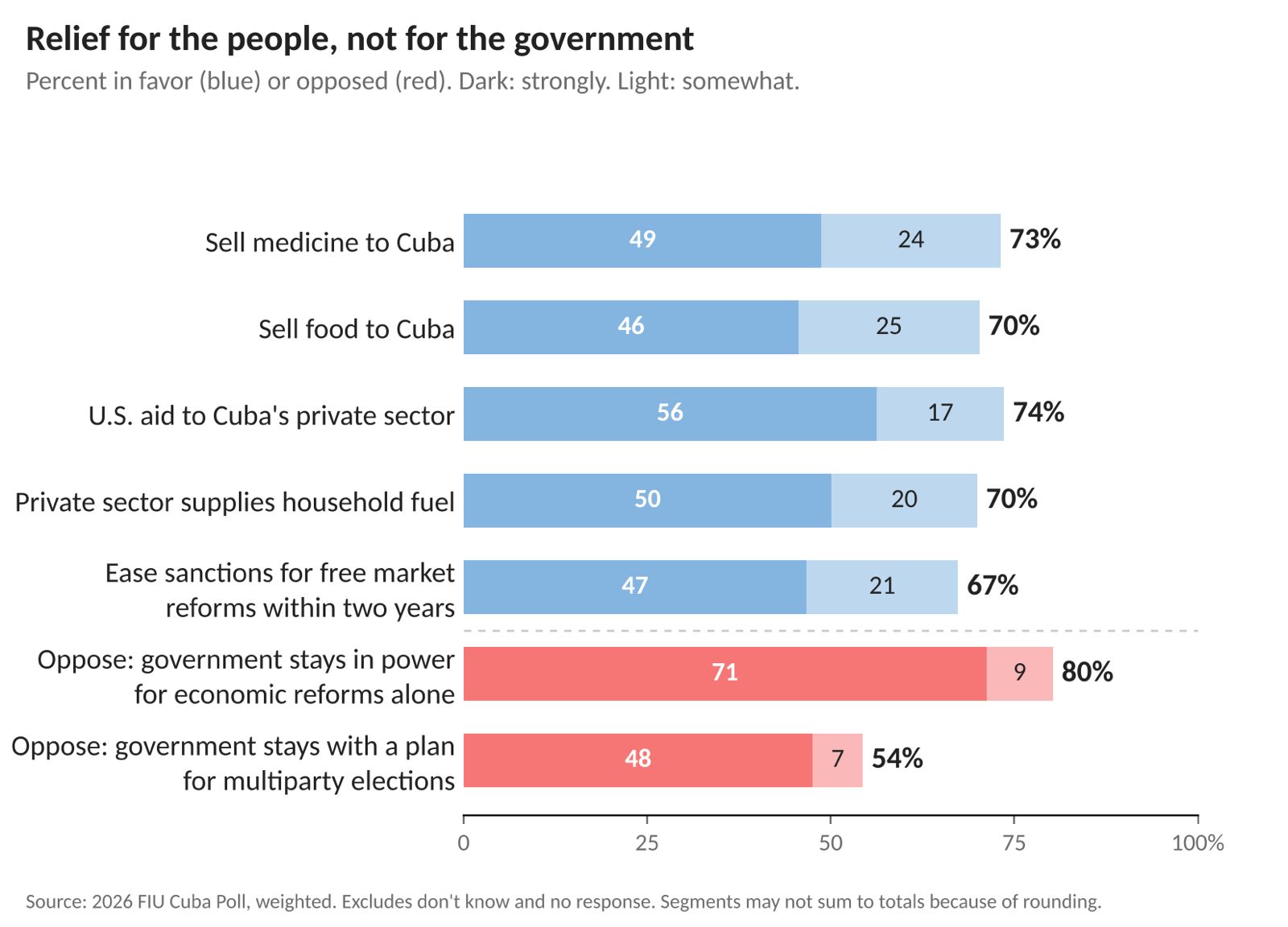
 Cuban Americans also separate the pressure from the pantry. Seventy-three percent favor allowing sales of medicine to Cuba and 70 percent favor sales of food. Sixty-nine percent say Washington should emphasize policies that help the Cuban people. Seventy-four percent favor U.S. aid to Cuba’s private sector, and 70 percent favor letting it play a larger role in supplying propane and other household fuel. Sixty-seven percent would grant sanctions relief in exchange for free market reforms, yet 80 percent reject letting the government stay in power in exchange for economic reforms alone, and 54 percent disapprove of its staying even with a plan for multiparty elections.
 Putting the pieces together we see that a large majority of Cuban Americans wants to exert the strongest pressure possible on the Cuban government, the Cuban people be damned. A smaller majority believes it will work as a catalyst of political change. Half accept the suffering of those on the island as the price to be paid for changing the political system. That acceptance rests on the belief that maximum pressure will work as intended. The poll can’t tell us how long Cuban Miami is willing to wait for results. And the people who pay the price do not appear in the poll at all.
The people on the island are waiting too. Four generations of the Silva Guerra family stretch less than sixty dollars through a month, and a neighbor’s seven-year-old comes by every morning to eat breakfast (Augustin and Poole González 2026b). In Santiago de Cuba, Yusimi Castellano, who has asthma, lights her charcoal with Styrofoam because the cooking gas ran out. “I shouldn’t be cooking with charcoal,” she told the Times. “But if I don’t cook, I die” (Augustin and Poole González 2026a).
Sources:
Augustin, Ed, and Jack Nicas. 2026. “Cuban Patients Are Dying Because of U.S. Blockade, Doctors Say.” New York Times, March 26.
Augustin, Ed, and Lisette Poole González. 2026a. “Out of Gas, Cubans Cook With Charcoal and Wood to Survive.” New York Times, May 25.
Augustin, Ed, and Lisette Poole González. 2026b. “How a Four-Generation Cuban Family Survives on $60 a Month.” New York Times, July 7.
Ferguson, Malcolm. 2026. “U.S. Military Prepares for Possible Action in Cuba.” The New Republic, September 25.




Grenier, Guillermo J., and Qing Lai. 2026. 2026 FIU Cuba Poll. Miami: Florida International University, Cuban Research Institute.
Nicas, Jack. 2026. “Cut Off From Fuel, Cuba Is Still Surviving.” New York Times, July 27.