Foreign Minister Bruno Rodríguez Parrilla called on the United States government to answer questions from Cuban entrepreneurs about the application of the measures announced by the Biden administration last May.
During the usual press conference that the Cuban Foreign Ministry (MINREX) calls every year to present its report on the impact of the blockade/embargo, before the vote in the UN on the issue, Rodríguez said that the possibility of opening bank accounts in dollars in the United States is inapplicable and so far no movement has occurred.
“They have not been applied because the oppressive and suffocating framework of the blockade prevents it. You have to be crazy to interact with Cuban entities under such oppressive circumstances. The risks for U.S. banks, for example, are very great,” said the minister.
The Foreign Ministry also questions how technology companies could discern between state-owned and private enterprises to offer Internet services that are currently blocked, another of the measures that the Biden administration announced in May.
It also recalled that non-immigrant visas are not yet being processed in Havana, which could benefit the exchange and search for supplies for private businesses in Cuba.
On the other hand, Rodríguez also considered that Washington’s announcements are unfeasible due to “the absurd and foolish intention to fragment the business system that is unique in the country” and that “a small private enterprise import, export, make international financial transactions and be abstained, that there be a glass wall that prevents it from interacting with the public sector of the economy.”
For the first time in the report on the blockade that Cuba presents to the United Nations every year, on September 29 and 30, the effects that the blockade causes specifically to the island’s private sector are collected.
In the text, the MINREX associates the economic losses of 685 MSMEs in 2023 with the effects of the U.S. sanctions.
Private businesses that benefit from visits by Americans to Cuba stopped receiving about $107 million in the last year, due to travel restrictions.
According to the Foreign Ministry, 163,455 citizens of that country arrived on the island between March 2023 and February 2024 and almost half stayed in private rental houses.


“Most of the services Americans enjoy in Cuba are in the private sector,” said Rodríguez.

Not everything is the blockade’s fault
Bruno Rodríguez acknowledged that the economic crisis in Cuba is not exclusively due to U.S. sanctions, but insisted that it is its fundamental cause.
“Not all difficulties are due to the blockade. There are also structural problems, difficulties in economic management, but the fundamental and determining weight is the extreme and unprecedented intensification and hardening of the blockade since 2019,” he stated.
According to the foreign minister, the island faces social inequality, “distortions” in the economy, low income, crime, corruption, weakening of social policies, especially in health, education and the protection of low-income families.
However, he considered that the errors in the management of the economy are “involuntary”, while Washington’s sanctions policy is deliberate.
Cuban authorities estimate the impact of the blockade at around $5.056 billion, from March 1, 2023 to February 29, 2024. “Some $200 million more than in the same period of the previous year,” said the minister.
He stated that Cuba’s GDP in 2023 would have grown by 8% if the blockade did not exist, in contrast to the 1.9% drop that was reported.
According to government estimates, the blockade’s impact after more than 60 years of application amounts to more than $164.141 billion at current prices.
A message for the next president of the United States
Bruno Rodríguez said he feels confident that the international community will once again vote almost unanimously for the end of the blockade at the UN General Assembly at the end of the month.
“This will be the welcome for the next president of the United States,” said the minister, who urged the future head of the White House to make up for the damage caused to Cuba.
He also stated that Biden has maintained Trump’s policy and that the possibility of easing sanctions, including removing the island from the list of State sponsors of terrorism, is in the hands of the Democrats. “He could do it tomorrow if he wanted to,” he said.
The island has suffered 1,064 actions of denial of services by foreign banks, due to being included in that list that harms, among other things, Cuba’s access to the international financial system.
Although the report presented includes one of the executive prerogatives that President Biden has to relax the application of the blockade — which could only be completely eliminated by Congress —, Rodríguez commented that under these circumstances, Cubans have the challenge of “overthrowing the blockade ourselves.” He thus hinted that, despite the impact of the sanctions on the island’s socioeconomic life, there is still room for maneuver.
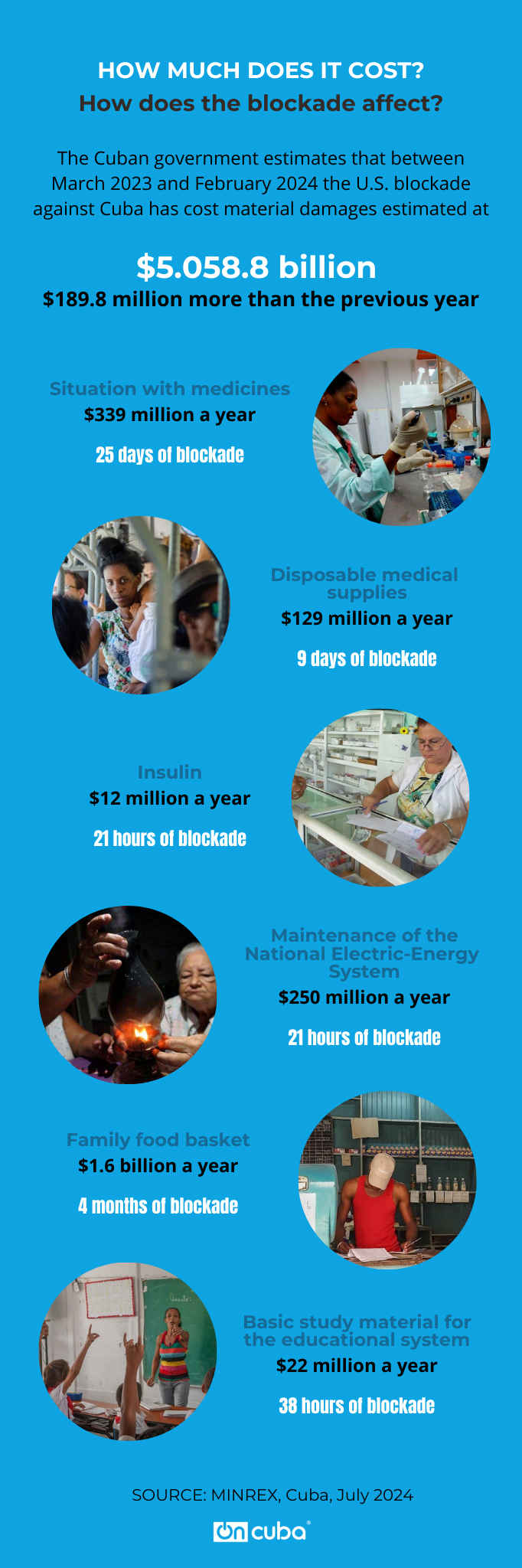

Blockade actions taken by the United States government between March 2023 and February 2024
March 31, 2023. The Office of Foreign Assets Control (OFAC) of the Department of the Treasury announced a monetary settlement of $72,230.32 with Uphold HQ Inc. (“Uphold”), a money services company based in Larkspur, California, for apparent violations of the “sanctions” programs against Cuba, Iran and Venezuela. Transactions involving Cuba totaled 25, for a total of $142,683.74, between March 2017 and May 2022.
April 6, 2023. Microsoft Corporation, based in Redmond, Washington, agreed to remit $2,980,265.86 to OFAC and $347,631 to the Bureau of Industry and Security (BIS) of the Department of Commerce, for violations of various U.S. coercive programs, including the one against Cuba. The total penalty amounted to $3,327,896. 54 of the 1,339 apparent violations were of the Cuban Assets Control Regulations.
May 1, 2023. Poloniex, LLC (“Poloniex”), headquartered in Delaware with its principal operations in Boston, Massachusetts, agreed to remit to OFAC $7,591,630 for violations of various U.S. coercive programs, including the one against Cuba. The agency’s statement said that the Poloniex trading platform apparently allowed clients located in “sanctioned” jurisdictions to engage in online transactions involving assets worth a combined $15,335,349.
September 29, 2023. By presidential memorandum, President Joseph Biden extended for one more year the restrictions on granting federal funds for cultural and educational exchanges with Cuba, among other measures. This action resulted from Cuba’s arbitrary and unjustified permanence in Level 3 of the Department of State’s Annual Trafficking in Persons Report.
November 6, 2023. OFAC announced through an official statement a monetary agreement with daVinci Payments (daVinci), a U.S. company that manages prepaid reward card programs, for apparent violations of several coercive programs, including the blockade laws against Cuba. DaVinci remitted $206,213 to the Treasury Department for apparently engaging between November 15, 2017, and July 27, 2022, in the exchange of reward cards from individuals in the sanctioned jurisdictions.
February 21, 2024. U.S. President Joseph Biden issued a notification extending for one year the State of National Emergency related to Cuba, declared by President William Clinton on March 1, 1996.
Source: MINREX, July 2024.
Prerogatives of the President of the United States to modify the application of the blockade against Cuba
Among the modifications to the framework of the blockade that the President of the United States could make from his executive prerogatives, and through regulatory announcements from the Departments of State, Treasury and Commerce, are:
- Remove Cuba from the State Department’s List of State Sponsors of Terrorism.
- Reverse the policy of financial persecution against Cuba, including that related to fuel supplies to the country.
- Suspend the possibility of filing lawsuits in U.S. courts against U.S. and third-country companies, under Title III of the Helms-Burton Act.
- Modify the permissible limit of 10% of U.S. components in goods that Cuba can import from any country in the world.
- Request the State and Treasury Departments to eliminate the inclusion of Cuban entities in other unilateral lists, such as the List of Restricted Cuban Entities, the List of Prohibited Accommodations, and the List of Specially Designated Nationals.
- Instruct U.S. representatives in international financial institutions not to block the granting of credits or other financial facilities to Cuba.
- Allow Cuban entities, including banks or companies, to open correspondent accounts in U.S. banks.
- Authorize exports to Cuba of U.S. products for key branches of the economy such as mining, tourism or biotechnology.
- Authorize the import by the U.S. of any merchandise manufactured or derived from products grown, produced, or manufactured in Cuba by state-owned enterprises (nickel, sugar, tobacco, rum or others).
- Allow the export to Cuba of medical supplies and equipment that can be used in the manufacture of Cuban biotechnological products.
- Make the licensing policy for investments by U.S. companies in Cuba more flexible.
- Authorize U.S. citizens to receive medical treatment in Cuba.
- Allow broader forms of collaboration for the development, marketing and supply of medicines and biomedical products of Cuban origin, for example, through direct investments by U.S. companies and joint ventures.
- Allow sales of raw materials that Cuba needs to produce medicines for the Cuban population and that of other developing countries.
- Authorize U.S. subsidiaries to do business with Cuba, which is not related to the import and export of goods to Cuba (prohibited by the Torricelli Act).
Source: MINREX, July 2024.