ES / EN
- March 22, 2026 -
No Result
View All Result
OnCubaNews
  • World
  • Cuba
  • Cuba-USA
  • Opinion
    • Columns
    • Infographic
  • Culture
    • Billboard
  • Sports
  • Styles / Trends
  • Media
  • Special
  • Cuban Flavors
  • World
  • Cuba
  • Cuba-USA
  • Opinion
    • Columns
    • Infographic
  • Culture
    • Billboard
  • Sports
  • Styles / Trends
  • Media
  • Special
  • Cuban Flavors
OnCubaNews
ES / EN
Home Cuba

Cuba sanctions state enterprises for not helping with public transportation

The General Directorate of Provincial Transportation of Havana has deployed dozens of inspectors at bus stops in the Cuban capital to control that state cars transport citizens who need it.

by
  • EFE
    EFE,
  • EFE
    EFE
March 4, 2020
in Cuba
0
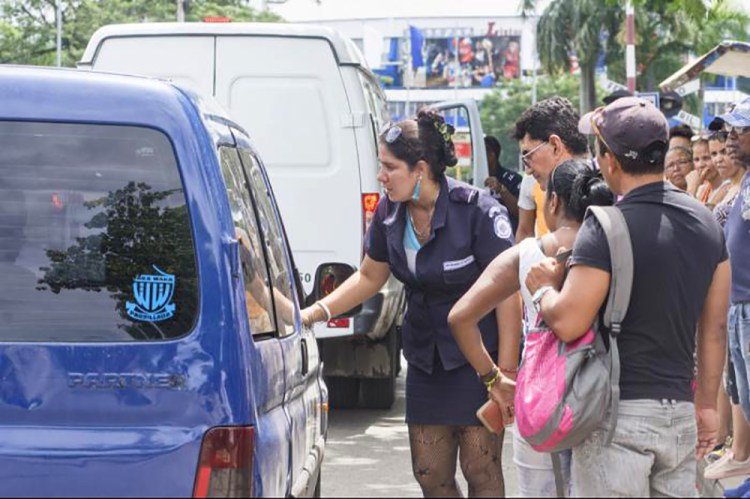
A state transportation inspector at a bus stop in Havana. Photo: Joyme Cuan/Tribuna de La Habana/Archive.

A state transportation inspector at a bus stop in Havana. Photo: Joyme Cuan/Tribuna de La Habana/Archive.

The Cuban authorities have applied 773 sanctions to enterprises, most of them state-owned, whose “unsupportive” officials did not stop their vehicles to pick up other people, in the middle of the economic crisis and the shortage of fuel affecting the island.

The measures were announced by the General Directorate of Provincial Transportation of Havana (DGTPH), which has deployed dozens of inspectors at the saturated bus stops in the Cuban capital to control that vehicles belonging to enterprises and state agencies, provided they have room, stop and transport citizens who need it.

Cuban President Miguel Díaz-Canel called on the drivers of state vehicles months ago to help alleviate the problems that the shortage of fuel is causing in the already overflowing public transportation.

https://oncubanews.com/cuba/baja-la-actividad-del-transporte-en-2019-en-cuba/

Last October, a state media published a photo of the president’s official caravan stopping to pick up people waiting for a transport on a street in western Havana, and around those same days Díaz-Canel was publicly outraged with officials with state cars that pass by the crowded stops.

Buying a car is a luxury within the reach of very few in Cuba, where the State has exclusivity on the importation of new cars and taxes them several times above their market value, which in turn makes vehicles used have an exorbitant price despite decades being driven on the streets.

Related Posts

Havana Malecón. Cuba

Flash: Havana that doesn’t go completely dark

March 17, 2026
Cardiovascular medical procedure in Cuba.

More than 96,000 patients await surgery amid U.S. oil embargo, warns health minister

March 14, 2026
Holy Greek Orthodox Cathedral Church of St. Nicholas of Myra. Havana

St. Nicholas of Myra: a Greek Orthodox church in the heart of Old Havana

March 11, 2026
Transport in Cuba. public transportation in Havana.

The island, the icebergs

February 23, 2026

The churches don’t stop either

The DGTPH report for February indicates that “inspectors located at the busiest stops in the capital” reported that 983 state vehicles “did not have that gesture of solidarity.”

The general director of the DGTPH, Maribel Poulot, cited by the state-run Agencia Cubana de Noticias news agency, said that the senior executives of the infringing enterprises “are called to analyze the infractions and the measures applied to those responsible.”

The enterprises denounced include not only state firms, but also several religious institutions, from the Archbishopric of Havana to the Methodist, Nazarene, Pre-Baptist, Evangelical, Piarist Fathers, Churches of Cuba and Acacia Sisters churches.

Also listed are some of the most prestigious exporting enterprises in the country, such as Habanos or the Havana Club rum, as well as several firms and agencies attached to the ministries of transportation, tourism, public health, energy and communications, as well as the Armed Forces, among others.

The largest number of vehicles that did not stop at the bus stops belongs to the Ministry of Agriculture, according to data from the DGTPH.

Fuel in the spotlight

Cuba is going through its most severe energy crisis in decades due to the intermittent interruption of the arrival of oil ships to the country, something that the government blames on the United States for the intensification of sanctions on the island and its ally Venezuela.

Recently the government revealed that it was forced to buy a ship that brought a cargo of fuel already paid for by Cuba, but whose owner did not dare dock in the country for fear of violating the U.S. embargo.

To address this scenario, which causes long lines at the gas stations from time to time, savings measures were approved in the state sector, many of which the authorities are committed to maintaining even if the situation stabilizes.

Temporary problem or structural crisis in Cuba?

The problems with diesel and gasoline have led to more bicycles and animal-drawn transportation on Cuban roads in recent months.

The island produces less than half of the crude oil it needs to meet its demand. For two decades it has received subsidized oil from Venezuela in exchange for the dispatch of professionals (especially doctors and teachers), but these shipments have collapsed in the last two years.

Fuel shortages have aggravated an already complicated scenario for Cuba, plunged into a complex economic situation due to the intensification of U.S. sanctions, the prolonged crisis in Venezuela, the inefficiency of the state business system and the loss of contracts for the export of medical services in several Latin American countries.

  • EFE
    EFE,
  • EFE
    EFE
Tags: cuban societyeconomic crisis in Cuba
Previous Post

U.S. deports 119 Cubans, the second group during Trump administration

Next Post

Carmen Herrera, the 104-year-old Cuban painter, will have a mural on the streets of New York

EFE

EFE

EFE

EFE

Next Post
Carmen Herrera while working on the adaptation of her work, executed in 1987. Photo: Jonathan Marder & Company/EFE.

Carmen Herrera, the 104-year-old Cuban painter, will have a mural on the streets of New York

F and 23 cafeteria, in Vedado. Photo: trabajadores.cu

No relationship between monetary unification and elimination of the CUC in state-run establishments

Slide of sound waves related to the suspicious sonic attacks suffered by North American diplomats in Cuba, presented during the debates of the Is There a Havana Syndrome? event held at the Cuban Neuroscience Center on March 2 and 3, 2020. Photo: Otmaro Rodríguez.

Is there a “Havana Syndrome”?

Leave a Reply Cancel reply

The conversation here is moderated according to OnCuba News discussion guidelines. Please read the Comment Policy before joining the discussion.

Your email address will not be published. Required fields are marked *

Most Read

  • The Enchanted Shrimp of the Cuban Dance

    5892 shares
    Share 2357 Tweet 1473
  • The story behind the “sister flags” of Cuba and Puerto Rico

    102 shares
    Share 41 Tweet 26
  • More than 96,000 patients await surgery amid U.S. oil embargo, warns health minister

    11 shares
    Share 4 Tweet 3
  • Flash: Havana that doesn’t go completely dark

    7 shares
    Share 3 Tweet 2
  • U.S. actress Susan Sarandon praises Cuban vaccines and calls for end of embargo against the island

    175 shares
    Share 70 Tweet 44

Most Commented

    • About us
    • Work with OnCuba
    • Terms of use
    • Privacy Policy
    • Moderation policy for comments
    • Contact us
    • Advertisement offers

    OnCuba and the OnCuba logo are registered® trademarks of Fuego Enterprises, Inc., its subsidiaries or divisions.
    OnCuba © by Fuego Enterprises, Inc. All Rights Reserved.

    No Result
    View All Result
    • World
    • Cuba
    • Cuba-USA
    • Opinion
      • Columns
      • Infographic
    • Culture
      • Billboard
    • Sports
    • Styles / Trends
    • Media
    • Special
    • Cuban Flavors

    OnCuba and the OnCuba logo are registered® trademarks of Fuego Enterprises, Inc., its subsidiaries or divisions.
    OnCuba © by Fuego Enterprises, Inc. All Rights Reserved.

    Manage Consent
    To provide the best experiences, we use technologies like cookies to store and/or access device information. Consenting to these technologies will allow us to process data such as browsing behavior or unique IDs on this site. Not consenting or withdrawing consent, may adversely affect certain features and functions.
    Functional Always active
    The technical storage or access is strictly necessary for the legitimate purpose of enabling the use of a specific service explicitly requested by the subscriber or user, or for the sole purpose of carrying out the transmission of a communication over an electronic communications network.
    Preferences
    The technical storage or access is necessary for the legitimate purpose of storing preferences that are not requested by the subscriber or user.
    Statistics
    The technical storage or access that is used exclusively for statistical purposes. The technical storage or access that is used exclusively for anonymous statistical purposes. Without a subpoena, voluntary compliance on the part of your Internet Service Provider, or additional records from a third party, information stored or retrieved for this purpose alone cannot usually be used to identify you.
    Marketing
    The technical storage or access is required to create user profiles to send advertising, or to track the user on a website or across several websites for similar marketing purposes.
    • Manage options
    • Manage services
    • Manage {vendor_count} vendors
    • Read more about these purposes
    View preferences
    • {title}
    • {title}
    • {title}