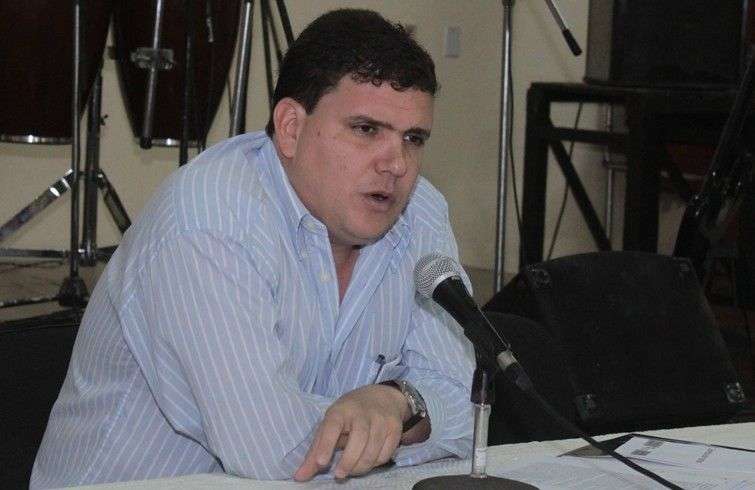
“In Cuba, there are people who believe the country can be transformed without legal reforms, or by implementing legal reforms later,” jurist and historian Julio Antonio Fernandez Estrada complains. It runs in the family: he is the son of the late Julio Fernandez Bulte, one of the most renowned of Cuban jurists, professor of several generations of law students at the University of Havana.
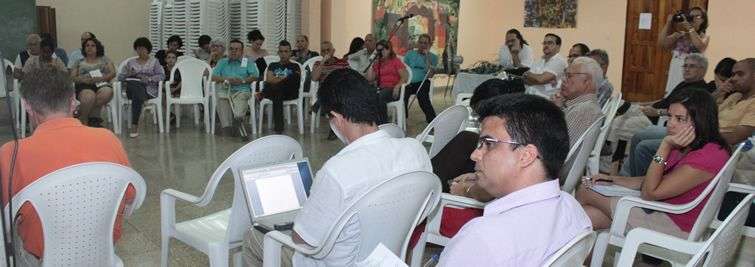
Last Saturday, Fernandez Estrada opened a workshop titled Pasado, Presente y Futuro de la Justicia en Cuba (“The Past, Present and Future of Cuba’s Justice System”), organized by the Cuba Posible(“Possible Cuba”) project at the Centro Cristiano de Reflexion y Dialogo (“Christian Center for Reflection and Dialogue”) in Cardenas, Matanzas.
His paper, El Derecho y la justicia en la identiad nacional (“Law and Justice in National Identity”) essayed a kind of summary of how national identity also draws from a certain conception of legality, stemming from Roman Law (which is at the root of Spanish Law), the persistently civic mindset of our first thinkers and independence war leaders, the constitutionalism of Cuba’s Mambi independence fighters and Jose Marti’s complex republican conception of “by everyone and for everyone.”
“We have gradually lost the tradition of regarding jurists and law experts linked to politics as important.” In the recent past, Cuba experienced a kind of “juridical nihilism”, a period of time in which no one studied Law and the teaching of Law focused entirely on its practical applications, in which the philosophy of Law was eliminated as a subject. This was coupled with the development of a certain degree of legal insecurity, stemming from the fact that Cuban laws, including the constitution, were not widely divulged and were mostly unknown to the public, because of scant legislative activity (a mere 119 laws were approved from 1976 to the present) and the overabundance of minor decree laws and norms that aren’t approved by Parliament, or owing to the secrecy, contradictions and imprecisions arising within Cuba’s (in some ways unsystematic) legal system.
“The letter of the constitution has been virtually frozen for 40 years. Today, in practice, we have many more rights than the constitution recognizes, which isn’t to say we don’t need many more rights.”
What’s most disquieting today, Fernandez Estrada says, is the way in which certain prejudices have survived and made it impossible to make headway in the area of rights. “Today, we continue to be the victims of prejudices regarding human rights and public policy concepts. We have to put these prejudices behind us if we aspire to establish the rule of law. If in 2015 we are still unable to speak about human rights in the State media, I fear those rights won’t appear in the new constitution” which is presumably being drafted behind closed doors.
Fernandez Estrada fears that the new constitution, rather than guide the changes in Cuba, will be used to ratify a specific politics. According to former Attorney General Ramon de la Cruz Ochoa, “the revolution has traditionally placed facts before laws.”
Such an instrumental conception of law is not the most appropriate, the professor believes. “The idea that law is merely an instrument fits well with the rigidity and top-down nature of the State. In some cases, public administration representatives benefit from a body of law that always comes to resemble what they’ve done. In other cases, on the basis of a more refined and conscious ideology, they take advantage of this to take away people’s ability to act,” he remarks in an exclusive interview for OnCuba.
“If we conceive of constitutional changes as a call for participation aimed at changing and thinking about the country in the long term, as the opportunity for a democratic exercise for the foundation of a new social pact in Cuba, we would not be content with laws that merely resemble the reforms we’re undertaking, but instead we could take on something more ambitious.”
Democracy Is Possible Under Siege
Nearly the entire history of the Cuban revolution has been that of a government besieged by an external enemy. These circumstances underpinned the idea that the republic could wait for many individual rights, rights that could be suspended in view of the urgent need to defend the sovereignty and independence of the country, understood as a totality.
“The heated debate between Agramonte and Cespedes is still relevant today. What kind of a republic do we want, civilian or military? Do we want a country that is ready for war or one based on the rule of law? The romanticism of placing the law above everything else, even in the midst of war, should be a source of inspiration for us today.




That, however, “is a very reductionist reading of what a democratic republic can do,” Fernandez believes. “It’s been demonstrated that the claim that we cannot have political pluralism, establish the rule of law or abolish the death penalty because that would make us weak before the enemy is a political reading of the situation, and that there was another alternative: that of fighting imperialism by distancing ourselves from it in all senses, to become increasingly democratic and pluralistic, to be more respectful of legality and create a true socialist alternative in the world.”
Cuba’s 1976 constitution does not describe the country as a “castle under siege.” For the historian, however, this conception has permeated political praxis and the interpretation of the law in Cuba, leading to the development of anti-democratic and anti-popular dogmas, such as the notion that “the people are not prepared” for a given change.
“If you said ‘let’s work to abolish the death sentence,’ they’d reply ‘no, the people aren’t ready for that.’ If one called for equal rights for different gender identities, the reply was ‘no, the people are male-chauvinistic and homophobic, they’re not ready for that’”.
“Well, the Cuban people weren’t prepared for socialism in 1959 and no one waited for them to prepare themselves adequately. The people weren’t ready for the criminalization of racial discrimination, having been brought up in a racist society, and we did it, because those laws were aimed at transforming society.”
The initial impetus of those processes then changed directions. This can be easily caught sight of, for instance, in the attitude assumed towards prostitution. “In the 60s, without any kind of socialist tradition behind us, we turned prostitutes into decent members of society, with trades. Later, however, when prostitution reappeared in Cuba, years after the revolution became established, we chose to sweep the filth under the carpet and started saying that what we need to do is “put away” jineteras in “educational” establishments (identical or similar to prisons) for up to four years, so they will not be seen by tourists. These are two ways of using the law: one revolutionary, one not.”
From all of recent history, Cubans should learn to grant individual rights, such as political participation and pluralism, with the same degree of importance than that accorded to the country’s sovereignty and independence.
“If you believe that democracy and human rights can be modified in dependence of the political context we live in, you fall straight into a trap,” Professor Fernandez Estrada insists.
“We’re still locked up in that trap as a country: our people don’t talk about human rights because they thinks it’s talking about counterrevolutionary groups. To date, it’s been impossible to open a Human Rights Faculty at the University of Havana, because the authorities have said it can’t be done. If you want to hold a conference about human rights, you have to call it by another name, because it is not well regarded.”
“We’re defensive about talking about it,” he adds. “We neither suggest nor defend the progress we’ve made on the subject, nor talk about what we need to do. We generally start by criticizing others to feel confident that what we have works. We never start by criticizing ourselves. We don’t have to compare ourselves to anyone. Rather, we ought to say: ‘we have to be better that what we’ve been.’ We need to give our people the best.”