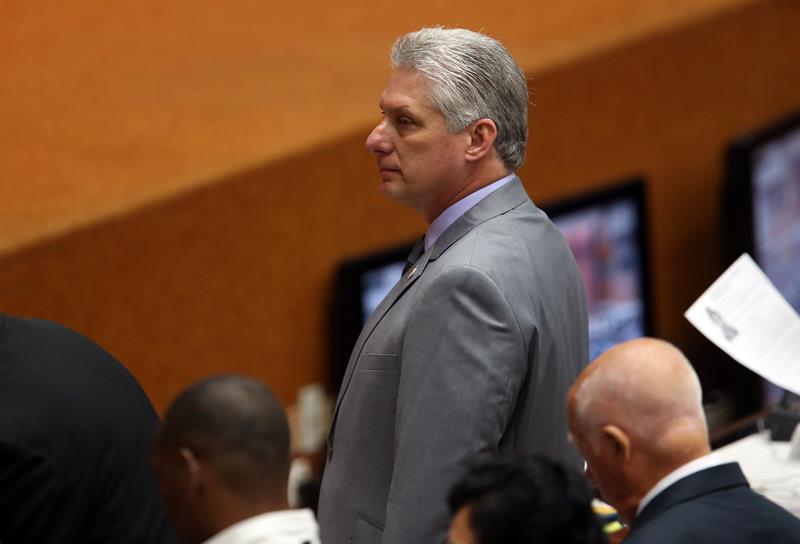
After a much awaited period of expectations and predictions, Miguel Díaz-Canel has received the presidential nomination. Unlike in the United States Electoral College system or the European parliamentary democracies, the Cuban electoral process is narrowly constrained by a National Assembly that nominates the president and elects the members of the Council of State and Ministers. The Cuban constitution of 1976, although amended in 1992 to remove limitations on foreign investments that began the ‘liberalization’ of the state-run economy, is a document inherited from the Cold War and specifically from Stalinist Soviet legalism.
As historian Rafael Rojas has argued, this constitutionalism is strictly designed to protect and empower the role of the Communist Party through all decision-making processes in the country [1]. This model has obstructed the flourishing of political and civil associations over a long period of time. If there is any hope in this new political transformation in Cuba, it is the much-needed constitutional reform that will begin early next year and move into 2020. If such reform were to advance, its impact would have deep effects not only on the island, but also in the international community, where Cuba has a major role to play.
The task will fall in the hands of Vice-president Miguel Díaz-Canel, the first non-Castro to spearhead the Cuban State after a decade of Raul Castro in power. During Raul’s regime, Mr. Díaz-Canel had moved up in the ranks within the Cuban Communist Party until Castro appointed him to the position of vice-president in 2013. Díaz-Canel is an electrical engineer and in the 1990s, was elected as the First Secretary of the Party in the Province of Villa Clara. He is a pragmatic administrator who is known for following orders. He embodies difference in contemporary politics. If compared to the wave of populist leaders around the world, Díaz-Canel yields a startling contrast: he is a thorough anti-populist with few personal ambitions. In contrast to Fidel Castro’s overwhelming authoritarian charisma and personalist hegemony, which throughout the long process of the Revolution severely undermined the democratization of Cuban society and state institutions, Díaz-Canel will have the possibility for democratic constitutional reform.
Democracies around the world since the sixties have experienced what Bruce Ackerman has called the rise of constitutionalism [2]. The new constitutionalism has been a fundamental catalyst in renewing a binding social contract for state and civil society relations. It is perhaps unrealistic to ask the Cuban state to undertake a full-fledged constituent process. Díaz-Canel will have at his disposal the institutional fabric inherited from the Revolution of 1959. A new generation of scholars, such as the historian Julio César Guanche, has argued that the desirable solution is to push for a new constituent process. For social anthropologist Vincent Bloch, Cuban reality after the disintegration of the Soviet Union is better understood as a quotidian ‘struggle’ (la lucha), a constant blurring of social norms and legal codes in everyday life practices [3]. But it is unrealistic to claim that the transformation of the legal fabric will have traction for the new regime. The reality is that many groups in Cuba –civil associations, Catholic intellectuals, the public opinion, artistic activists, and the moderate wing of the Communist Party– have been soliciting for a constitutional change for over a decade.
The complexity of Cuban society no longer revolves around highly mobilized social space as it did during the first decade of the revolution. The emergence of a new and more complex citizenship in the island is thus in desperate need for a new institutional framework that could guarantee them basic rights, economic mobility and expansion of freedoms. In the upcoming months, Díaz-Canel will find himself in a unique scenario to move forward with constitutional reforms that will grant an integral relation between state and society in these new times.
We have learned from Justice Elena Kagan and Woodrow Wilson that presidential charisma functions not only to attract loyal followers and to guide a political process, but also as a mechanism to redirect administrative institutions and the other branches of government. The lack of charisma in Díaz-Canel political profile most definitely works against the possibility of reform, which might make him the captain of a very slow-moving ship. However, the challenges are on the table and he will soon be in a position to lead the crafting of a new social contract that, for the first time in Cuban history, could allow for an improvement of Cuban citizenship and fundamental rights.
There are at least three challenges that deserve attention in the next two years of the political cycle. The first is an economic solution to the Cuban dual currency (the unification of the peso and the CUC), which is an obstacle to economic independence and isolates the island from global markets. The second, an improvement of bilateral relations with the United States and the Trump administration in the wake of the still unresolved “sonic attacks” on American diplomatic families. Third, and more important is an effective constitutional reform towards a new social contract. Díaz-Canel could propel a process of political legitimation that could displace the verticality of the Communist Party as single mediator between state and society.
These are challenges that, precisely due to the lack of political charisma, will be met with resistance by the more orthodox and “hard-line” wing of the Communist party. No matter what happens, Díaz-Canel will be the central actor in a drama that this time holds the possibility of healing Cuban society and constructing new horizons for the upcoming generations.

Notes



(1) Rafael Rojas. El cambio constitutional en Cuba (2017).
(2) Bruce Ackerman. “The Rise of World Constitutionalism” (1997).
(3) Julio César Guanche. “Democracia y reforma constitucional en Cuba” (2018). See Vincent Bloch’s important new book La Lutte: Cuba Après L’Effondrement de L’URSS (Vendemiare, 2018).
*Gerardo Munoz is Adjunct Professor at Lehigh University. His latest publication is the book Alberto Lamar Schweyer: ensayos sobre poética y política (Bokeh, 2018). He tweets @GerardoMunoz87