



For decades, agricultural production chain has suffered from the wear of their distribution and marketing chains.
The state collection system does not have all the sympathy of the farmers, who suffer excessive centralization and bureaucracy of this intermediary, which many will blame of the unilateral pricing, delinquencies in payment and collection, handling and transportation of the product inefficiencies that sometimes leads to the regrettable waste of food.
Professor Armando Nova discusses in his article the production and marketing chain in the agricultural sector in Cuba, recurrent changes in these areas before and during the revolutionary process, which has led to periods of estrangement between the farmer and the market.
A critical point in these relationships was experienced in late 2008. The state regulated the agricultural supply and imposed fixed prices to achieve a more or less equitable distribution of food following the ravages of three hurricanes. The move caused a shutdown of the productive forces, which at this point of the road is trying to reverse.
This requires a dynamic management of the production process. In the guidelines we can read the need to draw guidelines for the collection system transformation and agricultural marketing through flexible mechanisms that simplify the links between primary production and the final consumer.
Among the more coherent strategies is the possibility of selling the excess production, upon fulfillment of commitments to the state and the implementation of a legal package initially authorized direct marketing between forms of production cooperatives and entities belonging to the country’s tourist and now, in a second phase, open the same opportunity to small farmers, defined as land owners and beneficial owners.
So far, these producers were constricted to trade through the Credit and Service Cooperatives (CCS) and henceforth they are allowed to even create accounts in commercial banks to deposit money made in these new relations.
The elimination of traditional intermediaries (Selected Fruit Company, Miscellaneous Crops or Collection Company), is added to the diversification of marketable product in the regulations of 2011. To rice and charcoal , they added fresh flowers , ornamental plants , spices and dried seasonings , chicken and quail eggs, floral arrangements and gardening services .
The goal now is to create consistency between the provision of macro -level policy and implementation in small basic realities. The specialist of the Center of the Cuban Economy, Dr. Omar Everleny Pérez Villanueva, recounted their transit through the Hotel Pernik in Holguin, undersupplied entirely of fruits in their buffet table. “You travel to Guardalavaca, and on both sides are the wheelbarrows full of all kinds of fruits, the economist recalls.”Why do not you run what Raul says at the base level? There are still a number of bureaucratic obstacles that impede progress
Certainly this policy is not able to remove all the ballast. It will improve product quality, to the extent of the inputs they have on hand; it will definitely decrease food waste, and may even encourage a little import substitution in the tourism sector. But what happens to the population market, the market in which Cuban life runs? For this system collection will continue with his natural mediation, and the price system with his natural inflation.
In the markets you can stratospheric prices. Dr. Everleny Perez said that “Cubans use 70 to 90 percent of their salary to buy food”, with the inevitable widening gap between income and expenses, a worsening of social problems and corruption.
The vox populi provides part of the explanation of the problem: the peasants evade sometimes marketing with the State, because of the low prices, the delay in payment and collection inefficiency; they prefer this type of dialogue with resellers. The chain falls in legal limbo, which stimulates a healthy black market
Prices are spiked without mercy, and the result is a net gain for intermediaries, well above the producer’s at the expense of the open veins of his countrymen, pressed to put a plate on the table.
The Granma newspaper October 11, 2013, published the concern of the reader, D. Alvarez Rosales, in the face of the dissonance income-expenditure in a country where there is fertile pasture for the “fattening “of prices.” It seems to be a competition to see who sells at more expensive rates, making it impossible to cover all food needs with a salary or pension (…) One pound of beans costs 12 CUP and a pumpkin up to 22 CUP (…) The policy price does not reflect production costs, but with much higher profit plan than the purchasing power of the majority”
And this reflection goes for private and state, because it would be reductionist impaling only the self-employed person , without thinking on practices , not because they are common, but because they are contradictory. Roberto G. Peralo reflected on these issues in the La Joven Cuba blog: “The cost of producing a gallon of mash is 46 CUP, and the selling price established by resolution is 60 CUP (…) Who sells this product, the Ministry of Internal Trade (MINCIN), sells at a premium (…) is simply an intermediary who receives a profit margin close to 110 percent ” he exposes.
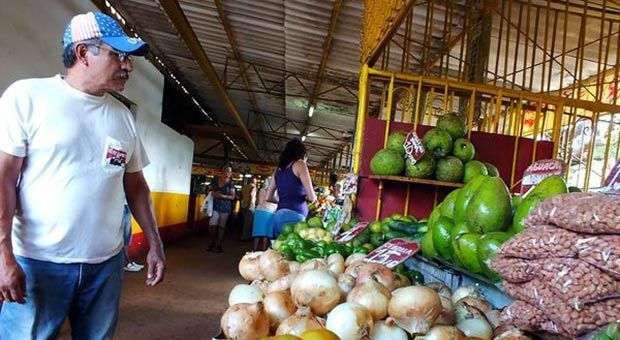
That overpricing you can see it in any green markets, retail outlets belonging to cooperatives and organic farms, State Agricultural Market (MAE) and Agricultural Market Supply and Demand (MAOD), without ignoring the street vendors. Some forms of commerce are supplied with each other and imposes their presence to the consumer.
In this minute approval is expected on a law of a new marketing method, in Artemisa, Mayabeque and Havana, which could generate new legal actors. An article in the Bohemia magazine warns that it is transforming “a significant part of the centers of these provinces marketers in agricultural cooperatives (…) They pay a lease for the property, they are free to buy produce straight from producers, and decide collectively the wages and earnings of associates. “But beyond the mode of sale, the “prices continue to be challenged” the article concludes.
While the Cuban peso appreciates to purchase food in the country and seeking the desired agricultural self-sufficiency, all government roads must reach the consumer. The null policies advocating their defense is becoming more vulnerable to inflation its subsistence is experiencing today.
Maybe it’s time to rethink national variants with their respective resolutions, ministerial support, system controls and penalties for those marketers who have profits significantly higher than production costs. Otherwise, a huge inflationary bubble could blow up in our faces, plunging an entire nation’s economic project into nothingness.
By: Malvy Souto Lopez
Photo: Abel Rojas
Series on the countryside in Cuba. You can also read
Notes for a radiology of the Cuban countryside
The countryside and the changes