Science is one of the possible links between the peoples of Cuba and the United States and protagonist of reconciliatory statements from both sides. OnCuba reproduces below an article from Juventud Tecnica specialized magazine that proves it.
By: Barbara Maseda
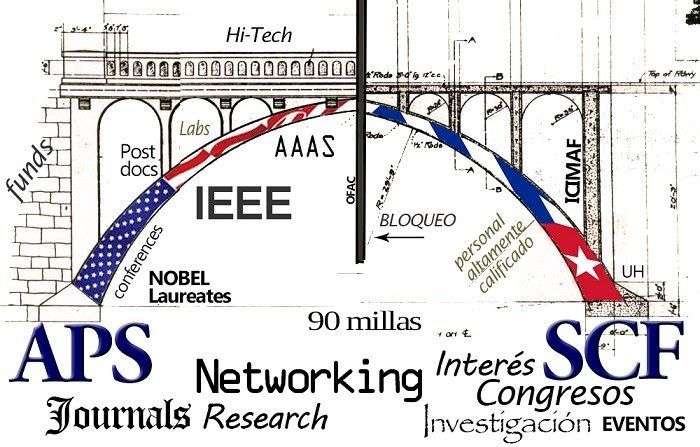
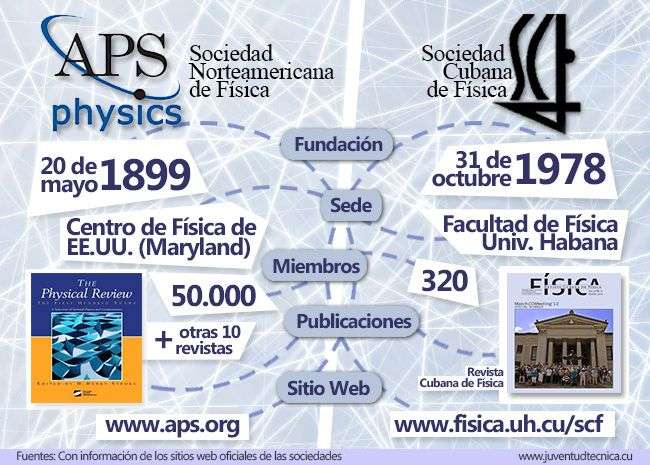
Building Bridges in Physics is the name that the Cuban Physics Society (SCF by its Spanish acronym) plans to give to a meeting to be held in 2015 to strengthen relationships with its colleagues in the United States.
“We will invite members of the American Physics Society (APS) and different universities with which we have maintained relations despite the obstacles,” said Dr. Maria Sanchez Colina, current SCF president. “It will not be a scientific event to present papers, but to approach representatives of institutions with which we have worked and others that we would like to collaborate, so seize the opportunity presented by this new situation.”
She refers to the context generated by ads from December 17, which could have a particular impact in the scientific sector both sides of the Straits of Florida.
The SCF-a nongovernmental organization made up not only by professors and researchers from higher level, but also by teachers of high school physics around the country- wants with this meeting, in the words of Sanchez Colina, “to break the ice”.
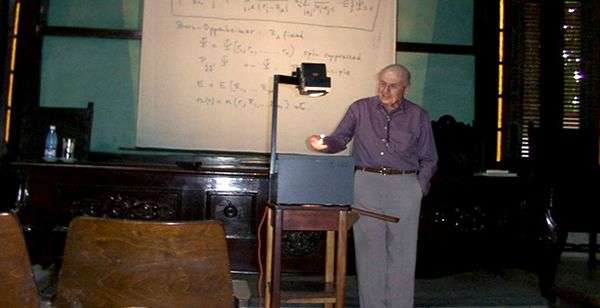
But the story of the thawing of US-Cuba relations in the field of physics began long before, through contacts she describes as “discrete” and have mainly consisted of visits by professionals to both countries.
Several Nobel Prize winners in Physics have been received in Cuba such as Leon Lederman (1988) and Murray Gel-Mann (1969); as well as Walter Kohn, a theoretical physicist who won the Nobel Prize in Chemistry in 1998; and Maria Tamargo, Professor of City University of New York (CUNY), to name just a few. These American scholars have lectured at the Faculty of Physics of the University of Havana (UH) and have met with other scientific organizations in the country.
But two or three isolated visits, subjected to approval expect and uncertainties do not make cooperation: “There are many professors and researchers who did even risk asking for permission. Now I’m sure they’ll want to come massively, “Sanchez Colina said.
Approach to the APS
There have also been exchanges of labor with the APS. Myriam Sarachik, one of its presidents, visited Havana, met with the Academy of Sciences of Cuba (ACC by its Spanish acronym) and lectured about her organization. Leo Kadanoff, professor emeritus at the University of Chicago, who was APS president in 2007, also visited Havana in 2012.
On the plans to strengthen ties with APS, Sanchez Colina stated that we should not forget that, although it is a very powerful and prestigious organization, the society of a country, and the relationship with them does not exceed the importance of belonging to other regional and international organizations such as the Latin American Center for Physics (CLAF by its Spanish acronym), the Latin American Physical Society (SLF by its Spanish acronym), the Ibero-American Physics Society (SIF by its Spanish acronym) and the International Union of Pure and Applied Physics (IUPAP). However, given the proximity and the level of APS, having more contact would be, of course, a goal.
“Many times we have offered memberships,” noted Sanchez Colina. “We’ve had several teachers who have been invited to become members. I know that Carlos Trallero Giner -current director of CLAF- already is it, just like Ernesto Altshuler, who was in the US doing a post-doc, despite the obstacles. Victor Fajer, former SCF president three terms ago, signed agreements with APS and attended one of its congresses too. ”
For physicists living in Cuba, it would not be easy paying annual memberships of that American organization, first for the price ($ 145-Regular / $ 73 young and more experienced practitioners / $ 36-Graduate students / $ 25-Undergraduates) which far exceeds the income of Cuban professionals, and secondly, by the lack of ways to make payments from the island to the US.
According to the website of the APS, the attractions of membership include using its extensive directory of members, attending meetings of the organization, participation in training programs and scholarships and access to much-date information through free publications and magazines / paid scientific papers that affiliates can acquire discounted.
IEEE
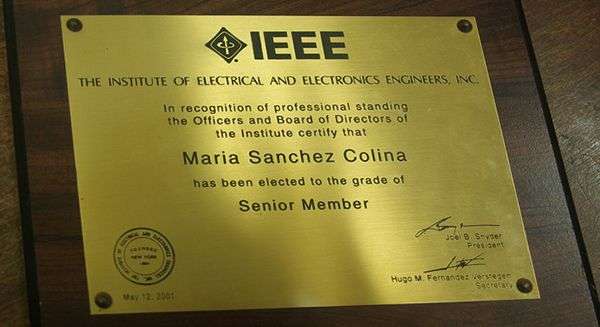
Dra. María Sánchez Colina thinks that restoration of relations could facilitate the resumption of the Cuban representation at the Institute of Electrical and Electronics Engineers (IEEE), the world’s largest association of technical professional. The Cuban chapter was removed in 2001, after the attack on the Twin Towers.
“Several teachers and researchers from the Faculty of Physics came to be Senior Members of this organization,” she said. “Our chapter, created in 1998, included twelve teachers. We organized events; I traveled to San Francisco for a meeting in 2000. We also received an annual allocation of funds that we consumed completely in paying our own memberships and subscriptions to two scientific journals we chose collectively. ”
The IEEE brings together professionals from around the world, but its headquarters are in New York, so international policy implemented by the US after the events of September 11 led to the direction of the organization to withdraw its chapter of Cuba, a country that was already included in the list of countries sponsoring terrorism.
“When our exclusion was announced, we received support from many Latin American countries that opposed the decision, arguing that the IEEE was an international organization”.
The incident left no grudges over here. Far from it, it is one of the links that, according to the president, should be retaken: “We have not had any negative experience, any problems involving separation. We want to strengthen these ties. In fact there are people from the Mexican chapter who already have contacted us with the opinion that this is the time to reopen the Cuban representation “.
Advantages and expectations
Besides relationships with organizations, the approach to US could give Cuba access to laboratories, purchase of equipment and the establishment of cooperation in the field of research.
“Since the crisis of the nineties the way we work changed,” the Dr explains. he It had been very different before that, thanks to our ties with the Soviet Union, but with the disappearance of all that we had to seek new markets and today much of our research results are due to international collaboration with Latin America and Europe. Our researchers and teachers travel to these countries, use the equipment there, make measurements, and then return to Cuba to process the results. The same applies to PhD thesis: no “Made in Cuba” doctorate is made exclusively here. We do not have the necessary facilities to do so. Then, having closer and top level cooperation possibilities would favour us, of course. ”
In its office at the Institute of Science and Technology of Materials where we met for this interview, there are some laboratory equipments where it is easy to recognize the Soviet hallmark of huge, crude apparatus and with the resistance of a WWII tank. This scruffy fleet of tools is the reason that the experimental part of the formation of Cuban physicists to currently be its weak point.
There is also an American-made oscilloscope that someone got of resale in Mexico for $ 2000, evading first the laws of the US blockade against Cuba and then the controls by local custom, where to avoid mishaps the traveller stated that it was “a printer”.
“When first world laboratories renew their technologies,” the president explains, “give or sell cheaper their equipment. There are websites where you can buy them, and it would be easier to bring them from closer. That would eliminate a number of obstacles and tricks you need to be doing to survive “.
Sanchez Colina, who was dean of the UH Faculty of Physics until July 2014, noted that on our side there are changes to be done to facilitate the exchange: “For an American professor to come to UH, we must apply for a permit three months before. That is not always possible so early in the way the world works today. We know, of course, there has to be some caution because someone could use the scientific front for other purposes, but we must not be unreasonable when enforcing the rules. I have the personal example of a visitor whose permission was denied by simply not meeting the application deadline, which was absurd because the person had visited us [authorized] previously. ”
United States, a country where they develop absolutely every possible lines of research in physics, is also a stronghold of meetings and conferences. “Scientists events are essential for the formation,” said Sanchez Colina. “It is not the same writing an article, with which you establish links with two or three referees and receive suggestions, no matter their important. Being able to have face to face contact with professionals in your same specialty is irreplaceable. ”
She added that the proximity of US would cheapen the passages regarding what is currently paid to fly to Europe (when possible), because high registration fees, which have increased from $ 150-200 to an average of 500 Euros, have almost canceled the presence of Cubans in these forums.
But the US blockade, still in force, is a big roadblock: “Paying to a Cuban living in Cuba goes against the laws of the blockade,” she said, “This prevents our teachers from doing doctoral stays taking benefits from a scholarship. There is a case of someone who did it, but making miracles “.
The Cubans cannot take economic advantage of their knowledge: “There is a page where companies post their problems for the public to contribute with solutions. Anyone from any country can participate. If a resident in Cuba would like to send his solution proposal, there is no way to pay him, she states. ”
The president thinks that the contribution of her discipline in a relationship with the United States would be at a theoretical level, since the preparation received by UH students of Physics is equivalent, in her opinion, to the one of the best universities in the world.
“We have nothing to envy to those universities,” she said smiling. “We do envy their equipment. But the preparation of our students is up to the highest international level. The limitation of our degree is the experimental part. Our equipment is obsolete, but training that ultimately provides the tools to master cutting edge equipment, is good. It is proven that our students go to the world and succeed. Our graduates will not be disadvantaged. For an American professor being co-tutor of any of them can be very helpful. ”
About the research in which they could work together, she stated: “We are a small community in Cuba. Our discipline has had extensive development in solid state physics and condensed matter; this is the forte of our faculty. The Institute of Cybernetics, Mathematics and Physics (ICIMAF by its Spanish acronym) has a Theoretical Physics Group, with very good results; it is a small group of about ten people. In the central part of the country they are working in cosmology, and in the East there is further development in Medical Physics. ”
“We are expectantly,” she summed up, “eager to make it happen; that most American teachers to visit us, and to continue receiving great figures of physics “.