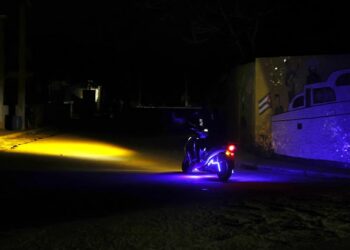
Mario Conde walks through the streets of Havana. He’s in his fifties, dresses carelessly, is an insatiable drinker, divorced, the owner of a fish called Rufino, with loads of books and a bunch of friends. A guy who left his career as a writer to become a police detective. Disillusioned and deeply melancholic. That’s how Cuban writer Leonardo Padura’s most known character in the series Cuatro Estaciones en La Havana (Four Seasons in Havana) is presented for the first time on screen.
They are four chapters based on Padura’s detective novels, whose main character is a detective that solves cases of any criminal variant and investigates the “dark zones” of the capital: drugs, corruption, social climbing and the trafficking in influences of a part of Cuban society of the 1990s.
Cuatro Estaciones en La Habana has been available on Netflix since December last year, in the more than 190 countries where this platform offers services, including Cuba. It’s one of the first series entirely filmed in Havana being broadcast by the principal U.S. entertainment commercial company and, although Netflix did not participate in its financing, this platform acquired the broadcasting rights for the entire American continent.
Tornasol Films, the same producer of the Oscar winning film El secreto de sus ojos, was in charge of the production. For several years Padura’s novels had been sparking the interest of international production companies to adapt them to television or cinema, but it was this important company that was able to come to an agreement with Cuba on the project’s production and obtain the financing for its filming. “I was invited, together with Antonio López, to join this production and our links to it started then,” says Lilianne Rodríguez, the Spanish producer who formed part of the series, who confirms that Tornasol Films had already worked in Cuban cinema with directors from the island like Tomás Gutiérrez Alea and in several films by Juan Carlos Tabío.
The commercial agreement to film in Havana was established between the Cuban Institute of Cinema Arts and Industry (ICAIC) and the Tornasol Films production company: “we have a historic relationship with ICAIC and we presented them with the project so we could have all the necessary permits and authorizations for the shooting, as well as an important part of the production services,” she explained.

The talks between ICAIC and Spanish producers Antonio López and Lilianne Rodríguez together with Tornasol Films started almost two years before the series was premiered in 2016. “A production of this type means a long process of incubation for multiple reasons,” she comments, which is the same period of time required to make a series like this one in any part of the world for “its preparation, shooting and postproduction.”
In the case of Cuatro Estaciones en La Habana, ICAIC applied similar demands as those for other productions made on the island, “usually you hand them over the scripts, the information of the producers participating, the dates and what is needed for the shooting, as well as the permits to use drones in the filming.” The permits were also given to hire the Cuban actors, as is done with the rest of the productions made in the country.
Despite it not being a Netflix original, Cuatro Estaciones en La Habana had the important Wild Bunch TV distribution company, which, “after the series was finished, took it to Netflix as a proposal and the platform acquired the broadcasting rights.” In addition, “there have been other agreements that allowed its being broadcast on Spanish, Israeli, Italian, Portuguese and Australian television.”
Its broadcasting has not had the same luck in Cuba, the series’ broadcasting has been almost symbolic, since the limitations of Internet connectivity, and the restrictions to have access to forms of international payment like credit cards, make Netflix almost null on the island. Many Cubans have been able to see the series through the well-known weekly package that clandestinely distributes digital contents on the island. However, the open TV broadcasting in Cuba is a possibility not ruled out by the Spanish producers, who began the talks to propose the broadcasting of Cuatro Estaciones en La Habana by open television.
Working with Padura was an enriching experience for Spanish producer Lilianne Rodríguez: “I think this was a very special project, in the sense of brining to life on the screen a character created by him, Mario Conde, which marks and identifies his work.” To make an adaptation of four of his novels it was necessary to reach an agreement with the Spanish Tusquets publishers, which for more than 20 years has published his texts. In terms of the script, the structure of the character in the series is rather faithful to the novels. Like in the books, it takes place during the four seasons of the year.
The first chapter is based on Vientos de Cuaresma (1994; Havana Gold in English, 2008), a novel written in the middle of the economic crisis and of the Cuban spring when the hot winds from the south get here, coinciding with Lent. This story is about the murder of a teacher with an “impeccable” political and academic past and the search for a drug trafficker linked to the school where Conde studied. In this novel Mario Conde meets Karina, a sensual researcher who is a fan of jazz.
The second chapter is based on the novel Pasado Perfecto (1991; Havana Blue, 2007) and is about the disappearance of Rafael Morín, head of the Cuban Ministry of Industries. The principal suspect is Tamara, Morín’s wife and Mario Conde’s old love. The third episode of the series is based on Máscaras (1997; Havana Red, 2005). In the middle of Havana’s dog days the body of a transvestite appears strangled, the son of a Cuban diplomat. Speaking of this case, Mario Conde is able to leave the office routine to enter the gay world of the capital.
The last chapter has as reference Paisaje de Otoño (1998; Havana Black, 2006), a novel that tells the story of Miguel Forcade, a former official and art collector who one day appears dead in Havana’s Playa del Chivo. The four episodes – each one 90 minutes long – is one of the audiovisual series that reflects the complex Cuban reality of the Special Period, “full of utopias and lost hopes,” according to what the author himself has said.